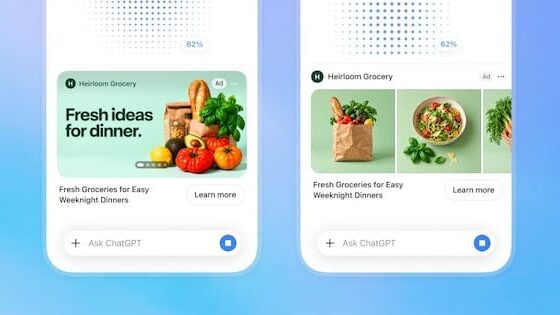
ChatGPT’s ad program is gradually evolving. After some ups and downs, the program has seen better luck lately, including its recently-boasted $1 billion annualized revenue run rate. Just weeks later, it has now brought us another milestone: a new visual display ad format is joining its lineup.
This new ad unit isn’t just defined by its visual nature but the visual context in which it appears. In other words, this is an ad format meant to be shown alongside generative AI visual results. So when you ask ChatGPT to create an image of penguins playing poker, you’ll see contextually relevant display ads.
This raises questions around commercial intent, and if it’s high among users generating images. And do visually-similar ads tap into commercial needs that those users have? Theoretically, this would appear to be less commercially relevant than text searches and ChatGPT conversations, but we’ll wait and see.
Currently in closed beta with a select group of early partners, the ads will begin to appear later this month in the U.S. Like its existing slate of ad formats (more on those below), OpenAI says that these display units will be clearly labeled as sponsored, and won’t influence organic results in any way.
Reinvent the Wheel
To put this new ad format in context, what’s the current lineup of ChatGPT ad options? Prior to this week’s addition, there were three, which mirror typical search ad formats. That familiarity is deliberate, as OpenAI wants to reduce friction and not reinvent the wheel, nor have to educate the market.
To level set, here’s the primary options:
Sponsored Recommendation box: Ads appear below the organic response in a tinted box that’s labeled as sponsored.
Contextual links: These are more atomized and integrated ad units. They take the form of citations that are in or near organic answers. Though they’re infused closer to the organic content (such as a link next to a brand name that happens to be mentioned in the organic answer), they’re labeled as sponsored to maintain a church/state separation.
Bazaar Carousel: In the case of shopping-related queries, OpenAI is testing a carousel of products that let users scroll horizontally without leaving the chat. Like the above, and in all cases of ads, OpenAI specifies that sponsorship is always clearly labeled as such.
Visual Ads: The latest format, launched this week and explained above.
Gravitational Pull
Stepping further back, what’s the background and historical context around OpenAI’s ad program? More importantly, why did it go down this road in the first place? First off, the move isn’t surprising, as AI search carries the same attribute that makes traditional search such a lucrative ad medium: intent.
In fact, AI search has greater capacity for intent inferencing, given nuanced questions that AI engines conditione users to ask. In other words, full sentences. This engenders what we call conversational intent, and ChatGPT evokes plenty of it. In the end, there’s a gravitational pull towards ad monetization.
With that backdrop, OpenAI’s biggest driving factor is putting itself in a position of competitive advantage and P&L strength. The latter points to the timing around ChatGPT ads, given a looming IPO. This also signals OpenAI’s motivation to invest in the program and evolve it rapidly in the near term.
Translation: expect more rapid-fire rollouts – especially in targeting capabilities and ad formats. Meanwhile, the big question is if this will drive net growth in aggregate search ad revenues or take share from others (read: Google) in a zero-sum market. The latter is more likely, but we’ll be watching.