A few years after the metaverse bubble deflated, we still see some vestiges of its principles. A subset of that movement involved a ‘real-world metaverse’ that promised a layer of data that annotates the world, unlocked through local discovery apps. That vision stands behind a new startup called Wrinkles.
Before getting into Wrinkles, let’s back up for context. The broader metaverse dream involved virtual domains that were place-shifted but time-synchronized, allowing users to interact in embodied ways. Accelerated by a Covid fever dream, it’s just like online social interaction but with 3D spaces and avatars.
But we all know what happened. In typical hype-cycle fashion, there was a herd mentality of excitement and investment that outpaced the technology. Realistic creation of a 3D web is years or even decades away. Moreover… no one was asking for it. It was a one-directional push from tech giants and press.
However, the ‘real-world’ version had (and has) legs. It asserts that dimensional digital interactions are better placed in our physical world, where we spend most of our time. Through your phone, AirPods, or smart glasses (audibly or visually), you can learn place-specific and situationally relevant intelligence.
Localogy even hosted a one-day event in New York in 2022 to take a sober look at this opportunity and where it could go. The idea was that if a real-world metaverse materializes, it will need all the folks in the Localogyverse to provide textured local data to underpin its functionality and content integrity.
Living Cities Launches to Accelerate the Real-World Metaverse
Real-World Wikipedia
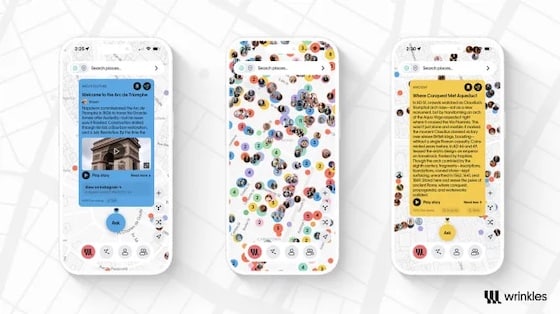
That brings us back to Wrinkles. The company launched recently to offer users short narratives about the places they encounter in the physical world. That can be historical back-stories and lore that’s activated in travel/tourism, educational and local commerce contexts (think: finding a restaurant).
Available on iOS and Android, the smartphone-centric UX is meant to act as a sort of audio tour guide that unearths hidden history and local stories about a given place. And though this idea has been tried by many such as Andrew Mason’s Detour (more on that in a bit), Wrinkle is hoping that the timing is right.
That essentially boils down to the availability of highly-capable off-the-shelf large language models. Wrinkles will unsurprisingly lean into AI to power the narratives at the center of its UX. This includes a voice interface, and the ability to engage in conversational dialogues to ask follow up questions.
Meanwhile, Wrinkles has 1.3 million points of interest established across 177 countries. That’s hoped to be a foundation to attract users, from which additional content will be crowdsourced. The company will rely on historians, creators, brands and others to populate the UX, sort of like a real-world Wikipedia.
This combination of crowdsourcing and AI raises questions about quantity (map coverage) and quality (moderation, etc) that will be uncovered in time. Meanwhile, the app will likely employ a freemium model that monetizes enterprise use (think: tour companies, museums, etc,) and affiliate local commerce.

Fun Facts
Whether Wrinkles flies or dies will hinge on if it can ingest and process a critical mass of real-world data. Having spotty coverage won’t fly, as low attention span users will quickly lose interest. This is an idea that the world isn’t sold on – the market has spoken – so whoever does it has to nail the experience.
This is a lesson that several companies have learned, including Layar, Detour, Yelp Monocle, Living Cities and Niantic. The latter, which developed and formerly owned Pokémon Go, is now called Niantic Spatial – a data company that’s building world models and other foundational elements of a real-world metaverse.
That transition from end-user app darling to back-end data play is reminiscent of the same process Foursquare underwent ten years ago. Speaking of Foursquare, its founder Dennis Crowley and former Niantic exec/acquiree Matt Miesnieks co-founded the aforementioned, and now defunct, Living Cities.
So what’s the lesson? First, the idea of an app that annotates the world with geo-anchored fun facts is compelling demo material. And one of these attempts will break through, possibly Wrinkles, but it has proven difficult to execute and to validate a market. Like the metaverse, demand is still a question mark.
Second, underlying data will be the key ingredient for Wrinkles or any other company to finally make the real-world-metaverse work. And as much as startups may try to deny its gravitational pull, that data will likely come from the Foursquares, Niantics and legacy location-intelligence players of the world.