Google reviews are one of the most powerful drivers of local visibility—but the rules aren’t the same for every business. New analysis of more than 50 million U.S. local search results shows that review competition varies dramatically by industry and market, challenging the idea of universal benchmarks. According to a recent whitepaper from Local Falcon, what counts as “enough” reviews is shaped less by best practices and more by transaction volume, competition density, and location context—forcing brands to rethink how they measure and manage review performance in Google’s evolving local and AI-driven search ecosystem.
Beyond being a trust signal, Google reviews play a critical role in local business visibility. They influence placement in the Local Pack, shape consumer perception, and increasingly inform AI-generated search responses and overviews. Yet one question continues to frustrate businesses and marketers alike: how many reviews do you actually need to compete?
The answer, it turns out, depends far more on industry than most realize.
Review Competition Isn’t Evenly Distributed
One of the most important insights to understand is that review competitiveness varies dramatically by industry. Some business categories require relatively few reviews to remain visible, while others demand an aggressive and ongoing review acquisition strategy just to keep pace.
The primary driver behind this disparity is transaction volume. Industries that naturally generate frequent customer interactions tend to accumulate reviews much faster, raising the competitive bar across the board. Restaurants and certain retail categories fall squarely into this group. In these industries, review counts escalate quickly, and businesses without a steady influx of feedback can struggle to appear prominently — even with strong ratings.
Meanwhile, industries with fewer annual transactions or longer sales cycles often face much lower review pressure. In those cases, a smaller but consistent review profile can still support meaningful local visibility.
The key takeaway is simple: what counts as “enough” reviews depends entirely on who you’re competing against.
For Multi-Location Businesses, Reviews Matter More Than Ever
Location Density Can Raise — or Lower — the Bar
Industry alone doesn’t tell the full story. Location density plays an equally important role in determining review competitiveness.
The data shows that businesses operating in dense metro areas often need significantly more reviews than those in suburban or rural markets to achieve similar Local Pack visibility. More businesses, more searchers, and more transactional activity create an environment where reviews accumulate rapidly — and expectations rise accordingly.
For multi-location brands, this creates a challenge. A review strategy that works well in smaller markets may fall short in major cities. Treating all locations equally can result in overinvestment in some areas and underperformance in others.
This reinforces the importance of market-level benchmarks, rather than relying on national averages or arbitrary targets.
More Reviews Doesn’t Always Mean Better Visibility
Another important nuance highlighted in the report is that visibility is not simply a linear function of review volume. While reviews matter, they interact with other factors — including proximity, relevance, and competition density — in complex ways.
In some industries, once a certain competitive threshold is reached, additional reviews may produce diminishing returns unless paired with strong operational signals and localized relevance. In others, falling even slightly behind the local review average can result in meaningful visibility loss.
This underscores why blindly chasing a specific review count can be inefficient. Understanding relative positioning is far more valuable than focusing on absolute numbers.

Review Recency Is a Continuous Requirement
One of the most overlooked aspects of review strategy is the importance of review recency.
Google Reviews are not a “set it and forget it” ranking factor. Even businesses that have accumulated a competitive number of reviews can lose visibility if review activity slows while competitors continue to generate fresh feedback. Local search algorithms reward signs of ongoing customer engagement, and stale review profiles can limit both Local Pack reach and broader AI-driven visibility.
This is especially relevant for high-transaction industries, where competitors may be adding new reviews daily. Maintaining visibility requires continuous participation — not just hitting a milestone and stopping.
Why This Changes How Businesses Should Think About Reviews
Reviews are often treated as a simple reputation score: get more, keep the rating high, and visibility will follow. But in reality, google reviews function more like a competitive signal — one that only makes sense when viewed relative to the businesses around you, in your industry.
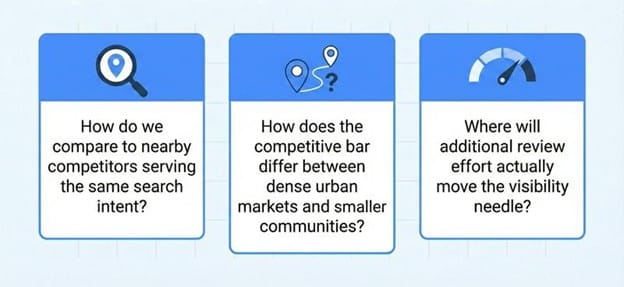
A strong review profile isn’t defined by an arbitrary number. It’s defined by how a business stacks up within its specific category and market. That shift in perspective changes the questions businesses should be asking. Instead of focusing solely on whether their reviews are “good,” more strategic questions come into focus:
- How do we compare to nearby competitors serving the same search intent?
- How does the competitive bar differ between dense urban markets and smaller communities?
- Where will additional review effort actually move the visibility needle?
When reviews are viewed through this lens, they become a tool for prioritization and resource allocation, not just a vanity metric.
Why Context Matters More Than Raw Numbers
One of the biggest pitfalls in local marketing is relying on generalized benchmarks. What works for one industry, or one city, may be ineffective — or excessive — elsewhere. Google Reviews requirements are shaped by transaction volume, competition density, and consumer behavior, all of which vary widely across markets.
Without context, it’s easy to chase the wrong targets: investing heavily in review generation where the competitive bar is already low, or underestimating the effort required in industries where reviews accumulate rapidly. Understanding how reviews function within specific industries and locations allows businesses to move beyond guesswork and focus on the efforts that actually influence visibility.