

As AI-driven search changes how people find local businesses, multi-location marketers face a new challenge: helping stakeholders understand what AI visibility is and why optimizing for AI search across locations matters so much.
Most multi-location brand leaders already value cross-location visibility on Google Search and Maps, but a new layer of discoverability is emerging — one that’s harder to see but increasingly essential for staying competitive, especially for multi-location businesses. Explaining this shift clearly is now part of every local marketer’s job.
What AI Search Visibility Actually Means
Traditional local SEO focuses on appearing in Google’s 3-Pack and organic results. However, users are now increasingly asking LLM-powered AI assistants and search tools, like Gemini, ChatGPT, or Google AI Mode, for local recommendations. When they do, the AI generates a conversational answer instead of showing a list of blue links or business profiles. That answer often mentions a handful of local businesses it deems relevant and trustworthy.
AI search visibility refers to how often and how prominently your business is mentioned across these AI-generated results. If any of your locations aren’t being surfaced, they’re invisible to a growing share of potential customers — even if your traditional local rankings look strong.
Explaining AI Visibility To Gain Internal Buy-in
For in-house marketers, trying to gain buy-in from higher-ups for emerging trends is nothing new. But, while it might seem obvious to those of us working in SEO, the importance of AI visibility can be hard to convey to stakeholders because it doesn’t fit into the traditional dashboards and KPIs they’re familiar with.
Yet understanding and optimizing for AI search now is critical. Multi-location businesses that begin tracking AI visibility will gain insights competitors won’t — insights into which locations appear in AI answers, which don’t, and how that affects calls and visits and, ultimately, the brand’s overall success.
The key is to position AI visibility not as something separate from local SEO, but as the next evolution of local discoverability.
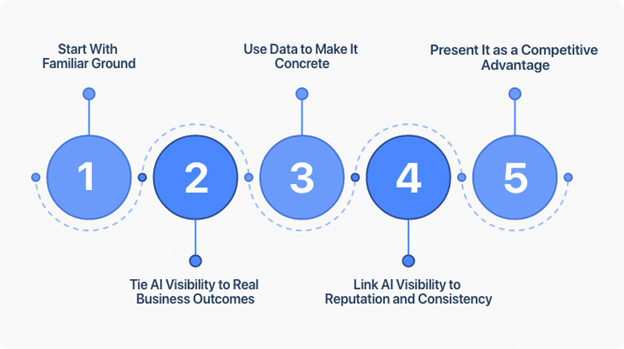
1. Start With Familiar Ground
Executives already understand the importance of Google visibility: ranking higher means getting found before competitors. Use that as your bridge, comparing being mentioned in AI-generated summaries, responses, and recommendations as equivalent to appearing in Google’s 3-Pack. If a location isn’t being mentioned by AI, an increasing number of potential customers aren’t choosing it, just like if they’re not seeing it prominently in Google Search or Maps.
This analogy connects new behavior to a familiar goal — staying visible when and where people are searching.
2. Tie AI Visibility to Real Business Outcomes
Stakeholders care about measurable results — calls, visits, and sales. Explain that AI search visibility drives the same outcomes. Even if users don’t click through to a business listing or website from AI results, they’re still choosing businesses mentioned by AI.
Many consumers now act directly on AI-generated suggestions, calling the top business listed or even visiting it immediately. These “zero-click” conversions may not show up directly in traditional analytics, but they have a very real impact on business outcomes.
Frame AI visibility as a way to protect and grow lead volume in an environment where traditional local SEO metrics no longer tell the full story.
3. Use Data to Make It Concrete
Showing evidence makes AI visibility easier to grasp. Local rank tracking tools like Local Falcon now let you track how often a business appears in AI-generated results across platforms. Visuals like AI visibility geo-grids and metrics like Share of AI Voice (SAIV) can clearly illustrate where your brand is being recommended — and where competitors dominate.
When leaders visually see the difference between markets, AI visibility shifts from an abstract idea to a measurable performance layer.
4. Link AI Visibility to Reputation and Consistency
AI models pull data from all over the web, including reviews, directories, blogs, news sites, and social content, to decide which businesses to recommend.
That means a location with strong reviews, consistent listings, and frequent positive local mentions is more likely to appear in AI-generated answers than one with outdated, inconsistent data or mixed feedback.
Explain that improving AI visibility doesn’t require reinventing your strategy, just strengthening the same fundamentals that already drive local success: performance tracking, reputation management, citations, and high-quality localized content are all essential.
5. Present It as a Competitive Advantage
Make it clear that this isn’t about catching up, but rather about leading. Many competitors aren’t monitoring AI visibility yet. Early adopters who start tracking it today will understand how AI models perceive their brand long before the rest of the market catches on.
Reassure stakeholders that AI search isn’t replacing Google — it’s offering new ways for users to discover brands. Just as early optimizers of Google Business Profile gained an edge in local results, those who embrace AI visibility now will compete more effectively in the next evolution of local search.
Turning Understanding Into Action
Helping stakeholders understand AI search visibility is the first step towards making it measurable and actionable. Connecting it to brand consistency, reputation, and customer behavior helps marketers make the concept tangible — and justify the investments needed to improve it.
AI-powered local search isn’t some distant trend. It’s already shaping how consumers choose local businesses. Tracking and strengthening AI visibility ensures customers can find your brand no matter where or how they search.