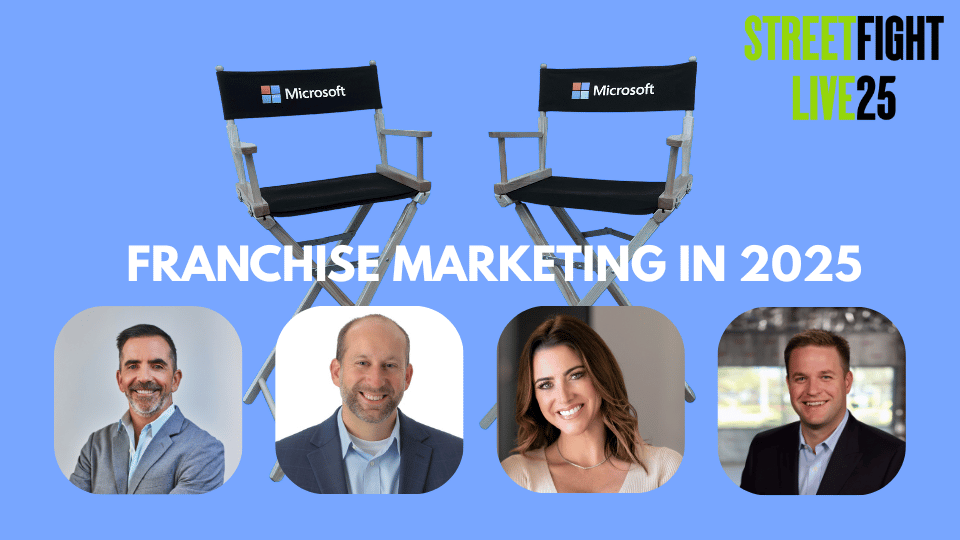
Franchise marketing continues to be a double-edged sword. It presents challenges that exceed standard challenges of local marketing & commerce. But when done right, franchise brands have a natural advantage in local markets. This was the topic of a panel at last week’s Street Fight Live event.
Breaking down the panel’s takeaways, there are new dynamics and success factors facing franchise brands… and old/fundamental factors. The new dynamics are led by AI, as expected. As for the old dynamics, even though they’ve been discussed many times, they still represent areas of improvement.
Starting with the new dynamics, AI presents several opportunities for franchises and multi-location brands, just like it unlocks capabilities for any sector. But how do AI’s new capabilities translate and map to multi-location businesses? In short, it’s all about speed, automation, and performance.
Unpacking that a bit, consumers are getting better at using AI engines like ChatGPT and Google AI mode. They’re also using them more often in the aggregate, as seen in escalating usage figures. And just like local search is a subset of search, local queries continue to be prevalent within AI engines.
More importantly, says Choice Local’s Joe Soltis, users demonstrate greater intent when using AI engines. This can be seen in higher quality searches and greater conversion rates. Among other things, this should be a strong motivating factor for local businesses to position themselves for AI search.
First Line of Defense
That brings us to the emerging art of AI SEO or GEO (generative engine optimization). It can flow from the work that any brand has already done in traditional SEO, given similar ranking factors (more on that in a bit). But it can also be faster, says Solltis, with 60-90 days to see results, versus 6 months for SEO.
Beyond getting found in AI engines, it’s also about using AI to serve customers. AI can be a first line of defense in voice response systems, which can help multi-location brands reach operational efficiencies by scaling or freeing up limited resources. These can include relatively low-cost implementations.
Here, we’re talking about things like answering basic questions (think: hours of operation) or facilitating a booking, appointment, or reservation – depending on the business. This opportunity is being supported by the quickly-improving state of AI chat systems that can do things like nuanced tone and empathy.
Not only can these systems streamline a given franchise’s operations – including deployments across their franchisees – but they can better capture business leads versus current manual methods. As we often examine, the dirty little secret of local commerce is how seldom the phone gets answered.
This is ironic and unfortunate, said Scorpion CRO Jamie Adams, given all the money spent on marketing. It’s a weak link in the chain where leads – often those that were paid for – are squandered. That’s where AI can play a role in making sure that at least every incoming call is being addressed in some way.
Back to Basics
That brings us to some of the traditional and fundamental dynamics of franchise-based businesses. Answering the phone is one of them (or implementing AI to do so). Another fundamental challenge is reviews. And with many of the above AI advancements, this is becoming more important than ever.
In other words, reviews were always a strong ranking factor for SEO. With AI SEO, it’s critical. According to Soltis, the first 20 results in AI Mode have four stars and up in his research. Not only that, but search queries are more nuanced and detailed, meaning business info on reviews/listings sites is a key factor.
Another fundamental success factor for franchises is constant communication with franchisees. The latter should have a full understanding of marketing goals and brand ethos. That means meet with them often, and treat them as members of your marketing team, says Consumer Fusion’s Brynn Gibb.
That process will also go smoother if there are “rinse and repeat” templatized systems for marketing programs that franchisees can execute. After all, people buy franchises because they’re sestablished systems, says Adams. So those that don’t have tight marketing programs are dropping the ball.
Of course, there has to be room for geographic nuances and local flavor (think colloquialisms, menu items, etc.). But if a franchise can templatize 80 percent of its marketing practices through a kit – think, brand messaging, approved fonts, etc. – it can take lots of headaches and gray area out of the equation.