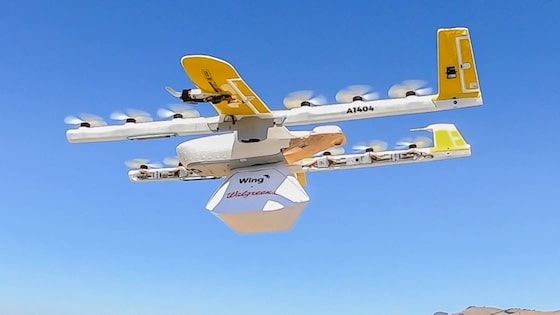
Google’s drone delivery division, Wing, just pushed things forward in local aerial eCommerce delivery, in partnership with Walmart. This follows similar moves and geographic expansions from Amazon, signaling an ongoing land grab – or airspace grab – in last-mile delivery to local markets.
Before getting into competitive dynamics, what’s the latest from Wing and Walmart? They’ve collaborated to launch drone delivery options at 100+ Walmart stores across Atlanta, Charlotte, Houston, Orlando, and Tampa. The two companies already work together at 18 Walmarts in the Dallas area.
This geographic expansion marks a 5x boost in Wing’s operations, which currently serves 60,000 homes. This growth is important as drone delivery is a business based on economies of scale. In other words, per-flight average cost declines with scale by amortizing fixed costs such as ground personnel.
To quantify that using the comparable progress being made in Amazon’s drone operations, it paid $484 for every drone delivery in 2022, which is projected to drop to about $63 by 2025. Both players will keep working on the economies of scale to get that average flight cost down, which is partly a volume play.
Line of Sight
Another factor contributing to the progress and evolution of drone delivery is regulatory shifts. The FAA recently relaxed its regulations on line-of-sight drone proximity. This allows the Amazons and Googles of the world to deliver items at greater distances, beyond destinations they can physically see.
Backing up for context, the FAA requires that drone operators maintain line-of-sight visual contact with their in-flight hardware at all times. This has made it difficult for Amazon and Google Wing to complete drone deliveries beyond a few hundred yards. So both invested heavily to find a workaround.
For example, Amazon’s Beyond Visual Line of Sight (BVLOS) technology gives drones autonomous-vehicle-like abilities to detect and avoid obstacles. The FAA was sold on the solution and lifted its line-of-sight requirements for Prime Air. Wing has done something similar, so both are free to go long.
Why is this important? Just like politics, aerial eCommerce is local. Though it involves transacting online with Amazon or Walmart.com or whomever, fulfillment happens at your doorstep. And competition over fulfilling that last mile to your doormat continues to heat up, per the expansion moves above.
The reason that the Amazons, Walmarts, and Googles of the world are investing so heavily in these aerial logistics systems is the prospect of avoiding gridlock at the last mile. So they’ve taken to the local skies to deliver packages – a concept that has always seemed futuristic but is getting closer to reality.
Double-Edged Sword
But the question that emerges from all the above is what are the implications, of aerial eCommerce for SMBs? For one, Amazon and Walmart’s pursuit of drone delivery could hurt SMBs. The more they can streamline fulfillment logistics, the more they can engage in aggressive price competition – a longstanding SMB killer.
But a more positive outcome for SMBs could be the eventual down-market migration of this technology. Amazon and Walmart are investing heavily in the underlying tech and regulatory workings, per the above. That could pave the way for smaller players as it – like most emerging tech – trickles down to SMBs.
By doing so, it could help SMBs improve their own delivery logistics or operational efficiencies. It could likewise make product or food delivery viable for the first time for some SMBs. That last part could result from giving them another option, and lessen reliance on margin-depleting and dreaded delivery apps.
But that down-market migration could take a while. It’s worth anticipating, but it’s not imminent. Amazon, Walmart, and others are meanwhile playing a long game with their last-mile drone programs. But as competition heats up between the two – and any other giants that enter – things could accelerate.