
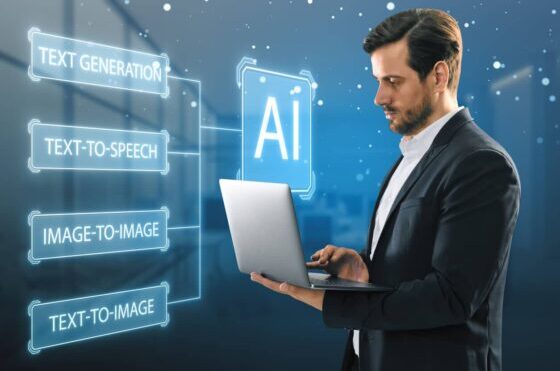
The (somewhat) recent announcement of AI agents from three major players in the AI market (Anthropic, Google, and OpenAI) is an interesting opportunity to pause, step back, and examine how these AI agents might play within the digital marketing ecosystem for local businesses. We can’t definitively know what the impact of AI agents will be in coming years (much too early), but it’s worth exploring to consider how the marketing mix might change as they improve.
Before we jump into AI agent ideas to consider for local digital marketing, we should define AI agents and why we can consider them a step forward for marketing. To start, MIT’s Tech Review has a comprehensive write-up that is certainly better than anything I could write. Here’s a short summary from GPT-4-Turbo with some slight modification:
“An autonomous model that can make decisions and complete tasks independently [by manipulating a web browser’s user interface] such as managing workflows, booking services, or handling customer queries. Unlike basic assistants, AI agents interact with users through language, audio, or video, process commands without supervision, and may access tools [i.e., browsers] or data to execute complex operations.”
It’s clear from this definition that AI agents are going to be capable of doing many of the mundane tasks consumers complete when making decisions via the internet.
Let’s imagine a scenario in which a consumer is looking for a new roof for his/her house. The AI agent is able to find local roofers by checking Google Business Profile service areas, schedule time for consultations with three roofing companies by manipulating the scheduling widget on the roofers’ websites, add the bookings to the consumer’s calendar, and provide the consumer a set of suggested questions to ask during the meetings with the roofers (generated by summarizing the top organic search results on what to consider when replacing a roof). The AI agent is innovative not because it can find roofers, but because it can do this without a direct API connection to a Google Business Profile, roofers’ websites, the consumer’s digital calendar, and various other data sources such as citations/directories. The AI agent can touch every service that the consumer wants to leverage without having to wait for engineers to connect to the API from OpenAI, Google, or Anthropic to execute those services; AI agents can simply do it themselves and without a single line of code.
AI agents are still in early development (and still making mistakes), but their potential impact in the local marketing world could be large. The potential to interact with services and provide value to consumers without the connectors of the internet (APIs) has huge implications. While some might worry that AI agents will replace the need for local marketing altogether, I believe that the coming of AI agents is well-suited for local digital marketing and, utilized correctly, could actually prove to be a huge value-creation tool for local marketers moving forward. Let’s consider three ways increased adoption of AI could shape the future of local digital marketing.
- Increased Growth for PPC/LSAs: Google has already given us their first pass at monetization for AI Overviews and we should expect the same from the AI agent world. In the context of our above example of a consumer replacing their roof, an AI agent would allow Google to have a dynamic bid system that is scheduling appointments (think a more powerful version of LSAs) with advertisers that meet certain criteria and the second-price auction clearing price.
- Technical SEO, Structured Data, and Scheduling Accessibility to Matter More: AI agents use technical SEO optimizations to read the internet and build models, so the more optimized your website is from a technical SEO standpoint, the better positioned you will be for an AI agent to manipulate your website and generate leads. It’s not unreasonable to predict that AI agents will be able to monitor consumer behavior on websites and pass that data back (similar to how Google monitors consumer behavior signals) for inclusion/exclusion adjustments. Using our above example, if the AI agent is deciding between three roofing contractors with the same ratings and one has a scheduling widget and the others do not, the model will choose the website with the scheduling widget to close the loop for the consumer faster. This isn’t to say that these AI agents won’t eventually be so multi-modal that they can just call a roofing contractor’s phone number, but they will certainly prioritize speed if they can improve the consumer experience. These types of AI/SEO optimizations websites could foreseeably be the difference in future lead generation.
- Brand/Awareness Marketing Will Grow: While the bucket for “brand” or “awareness” marketing is broad (let’s not try to define it here), visibility for local brands within their respective local markets will become increasingly important. It’s fair to assume that human traffic vs. AI traffic to websites will start to flip, while lead volume will remain consistent; instead of a website getting 10 leads from 100 human visitors, the website will get 10 leads from 100 visitors, 60 of which were AI agents. Again using our above example, if an AI agent is in conversation (actually talking and responding) with a consumer and presents the consumer with three similar roofing contractors to schedule, the human is likely to schedule with the contractor that has broader awareness/trust due to the brand advertiser the contract has done in the local market.
The AI agent world is still new, but could easily prove to be transformational in local digital marketing. Replacing API/connectors with AI agents allows systems and consumers to interact in unprecedented ways that we are only just beginning to ponder. We at Semify are focused on exploring these interactions between digital marketing and software to support local businesses. We encourage you to join us in exploring and experimenting.