
OpenAI continues to display mixed signals to the broader market. On one hand, the tremendous compute capacity required for generative AI has saddled it with an untenable burn rate. And it’s on pace to run out of money soon… though the company’s success renders it unlikely to not find cash infusions.
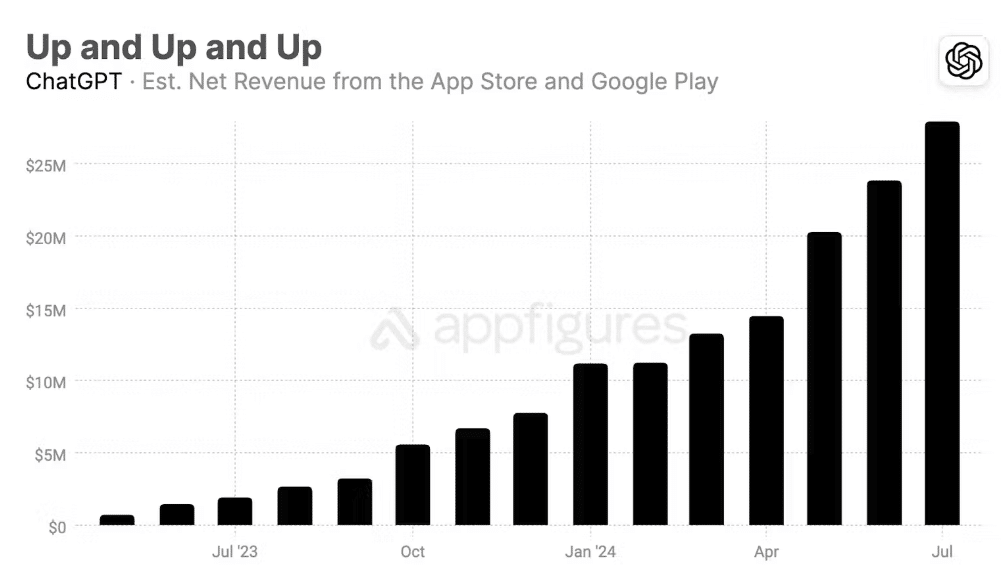
On the other hand, the company is a darling of the current AI wave. And that status continues to be validated by tangible milestones. The latest bar involves its mobile app usage and revenue. Specifically, the ChatGPT app derived $28 million in net revenue on iOS and Android in July, according to Appfigures.
As a definitional sidenote, “net revenue” is the amount a given company keeps after paying the app store tax. It should also be noted that Appfigures’ data are extrapolated from the activity it sees on its network – a reliable estimation but not first-party revenue figures from OpenAI itself… which it does not disclose.
Revenue & Functionality
Going by the above figures, ChatGPT’s revenue is up from 24 million in June, and just over 20 million in May. Altogether, it has grown in revenue every month with the exception of February ’24 when month-over-month growth was flat. 83 percent of the app’s revenue comes from iOS and the rest is Android.
Why such an imbalance between operating systems? It could be because iPhone users tend to be more affluent and tech-savvy, which are attributes that can align with personas who pay to upgrade to the paid version of ChatGPT’s app. iPhone prevalence also maps to more affluent geographic regions.
Another factor to extract from these data is the May release of GPT-4o. As you may remember, this was a sizable version release, involving ChatGPT’s Omni model that gained more conversational capability. This could be a meaningful insight for OpenAI in terms of correlating revenue and functionality.
Other notable upgrades in GPT-4o include greater multimodal AI functionality – a fancy way of saying it can handle a mix of text, voice, and video inputs & outputs. Response times also got a bit faster and you can interrupt the chat agent – one of the things that made the interface more “conversational.”
Generating Demand
It seems that these upgrades were enough to move the needle in terms of new premium users, as revenue growth was 40 percent, month-over-month in May. That growth has since slowed, but continues at a healthy pace. Appfigures estimates revenue growth will continue into Q3 and the foreseeable future.
This will be well-timed for OpenAI given, again, its cash burn. Meanwhile, it will continue to evolve its business model to further alleviate cash flow issues. Those measures include economies of scale and lower cost over time (a la Moore’s Law) for the compute capacity needed for generative AI.
Joining that factor will be business-model diversification. As we’ve examined, OpenAI’s real opportunity is software licensing for B2B2C. In other words, every consumer-facing brand in the world will want to have better chat agents for customer support and other functions. OpenAI could absorb all that demand.