

One of the biggest evolutions in local marketing and commerce over the last decade was the broader adoption of SaaS. Erstwhile consumed in martech, our coverage of the SMB universe expanded from how they promote themselves to how they run their businesses. It’s all about day-to-day operations.
The latter is where SaaS comes into the picture, empowering businesses in areas ranging from operations and finance to CRM and supply-chain management. This has effectively broadened the opportunity in the SMB world, including the many software vendors that sell into it.
This was the topic of a live presentation and panel that we participated in last week. Hosted by website platform Duda, we had a lively and data-rich research discussion for almost an hour on how SMBs are adopting SaaS. We broke down overall adoption patterns, functional areas of adoption, and other key drivers.
All of this rested not only on speaker insights but hard data. It was based on two research reports: Localogy’s Modern Commerce Monitor (MCM): The State of SMB, Wave 9, and Duda’s survey that it fields to a diverse sample of SMBs. In most cases, the research data aligned, which was validating to both studies.
If you missed the discussion, we’ve got you covered. You can watch the entire conversation below, and/or keep reading for some of our highlights and takeaways. For an even deeper dive, request your own copy of Localogy’s latest State of SMB report, Wave 9.
Flattening Effect
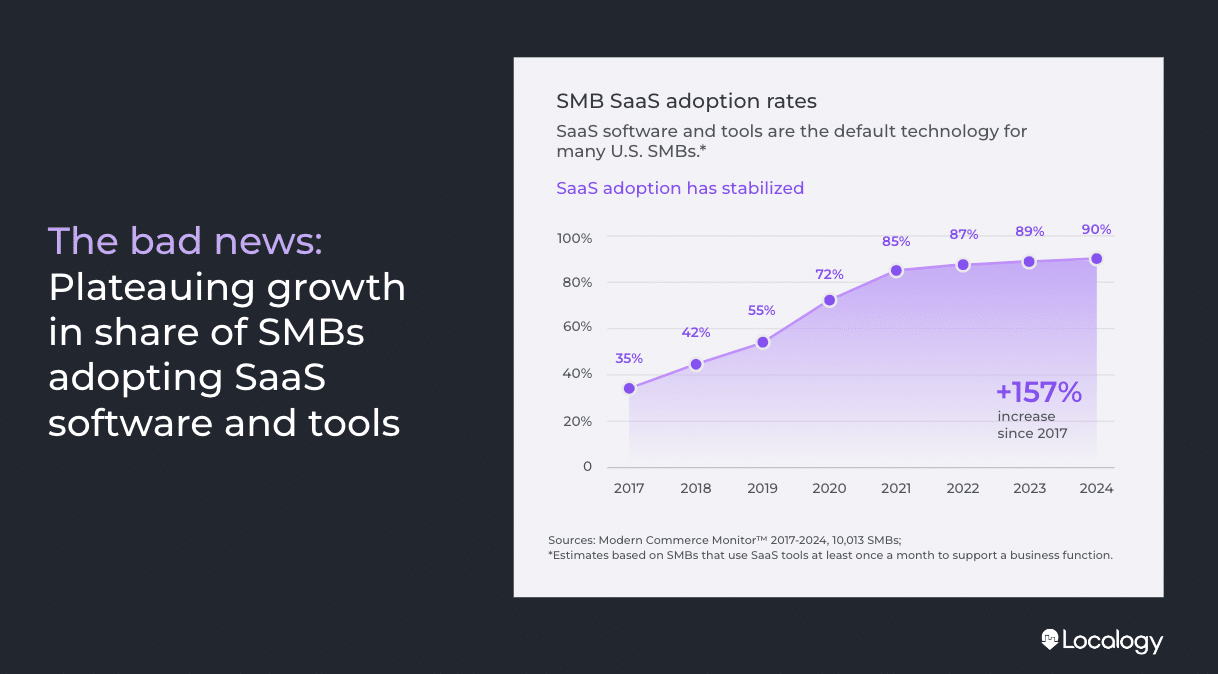
Jumping right into the takeaways, we started with some bad news. Specifically, SMB SaaS adoption has reached 90 percent. And with that maturation comes a flattening effect. Specifically, SMB SaaS adoption grew by 30 percentage points from 2019-2021… then only 5 points in the subsequent three years.
There are a few reasons for this deceleration. The first is Covid. The boom in software adoption and SMB digital transformation that we often discuss was real… but so was the Covid hangover. The second reason is basic mathematics. As markets mature, growth decelerates as a saturation point is reached.
Quantity & Quality
So as the share of SMBs adopting SaaS approaches a natural ceiling, a burning question emerges: Where will growth come from? The good news is that other sources of growth and demand signals are evident throughout the MBM results. Two that stand out are quantity of SMBs and spend per SMB.
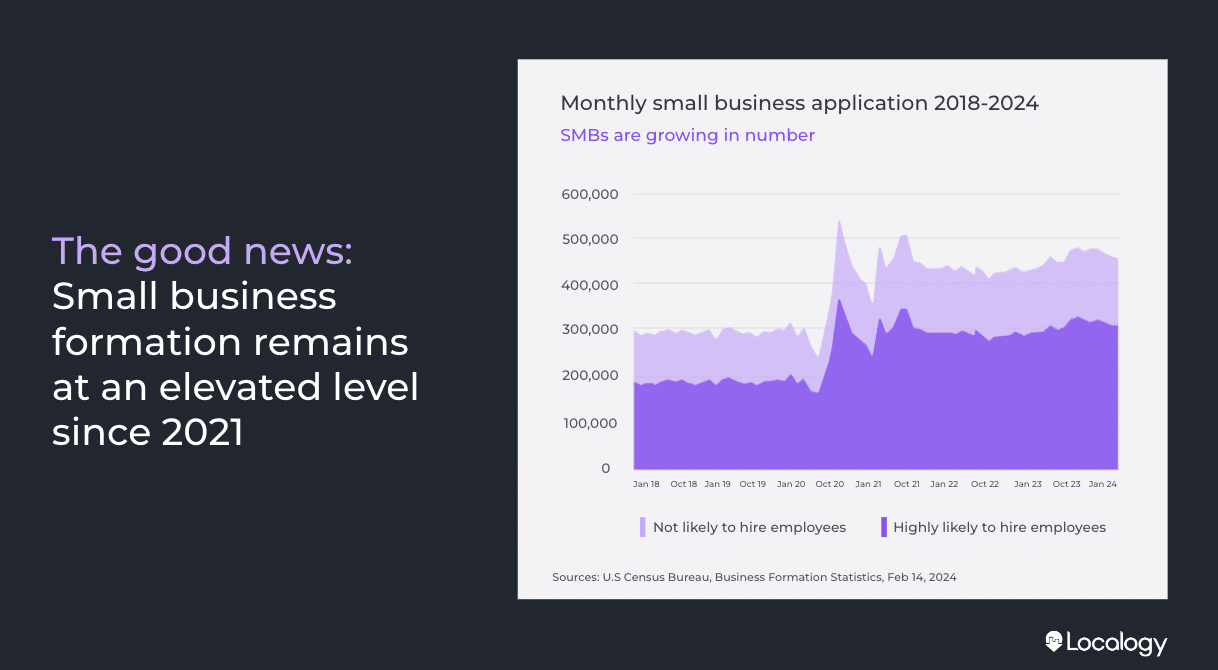
Taking those one at a time, though 90 percent of SMBs already adopt SaaS, the remaining 10 percent represents the largest slice of pie that it ever has. Specifically, the U.S. Census Bureau reports an uptick in new business applications. This inflected in late 2020 and hasn’t since returned to pre-Covid levels.
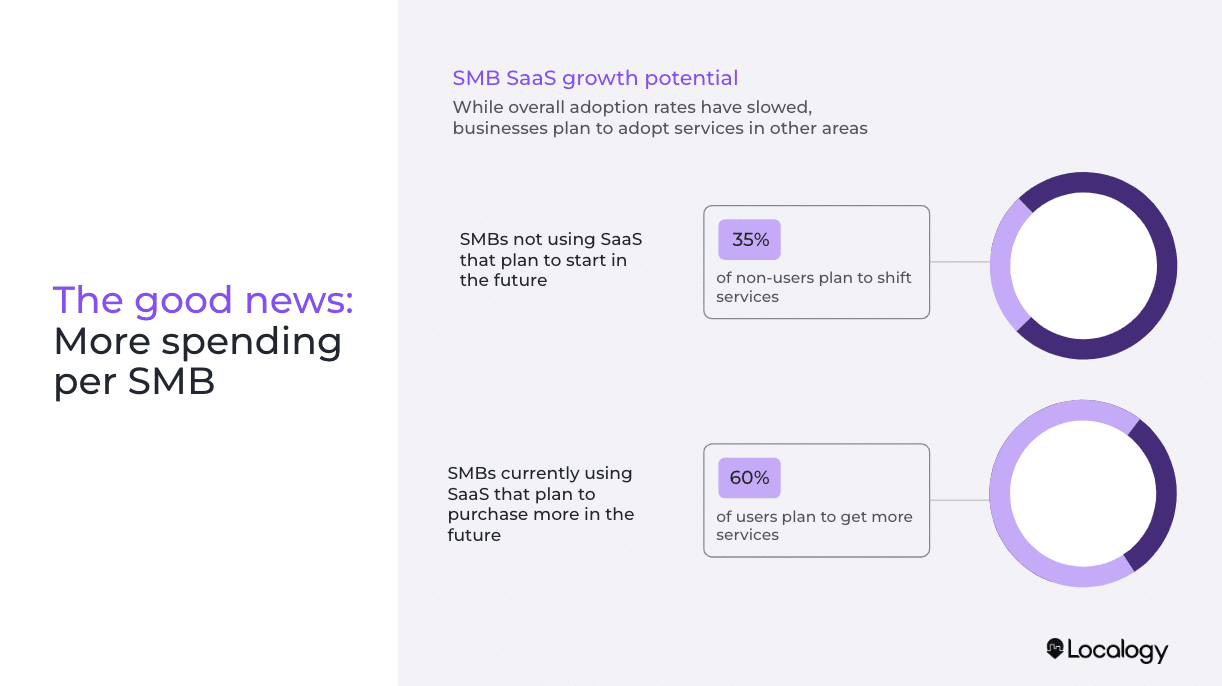
As for the spend per SMB, that’s likewise good news. Localogy’s research shows that among SMBs who haven’t yet adopted SaaS, 35 percent plan to do so. But more to the point, 60 percent of current SMB SaaS adopters plan to increase their spend over the next 12 months. This has strong implications for SMB SaaS vendor ARPU goals.
Across the Board
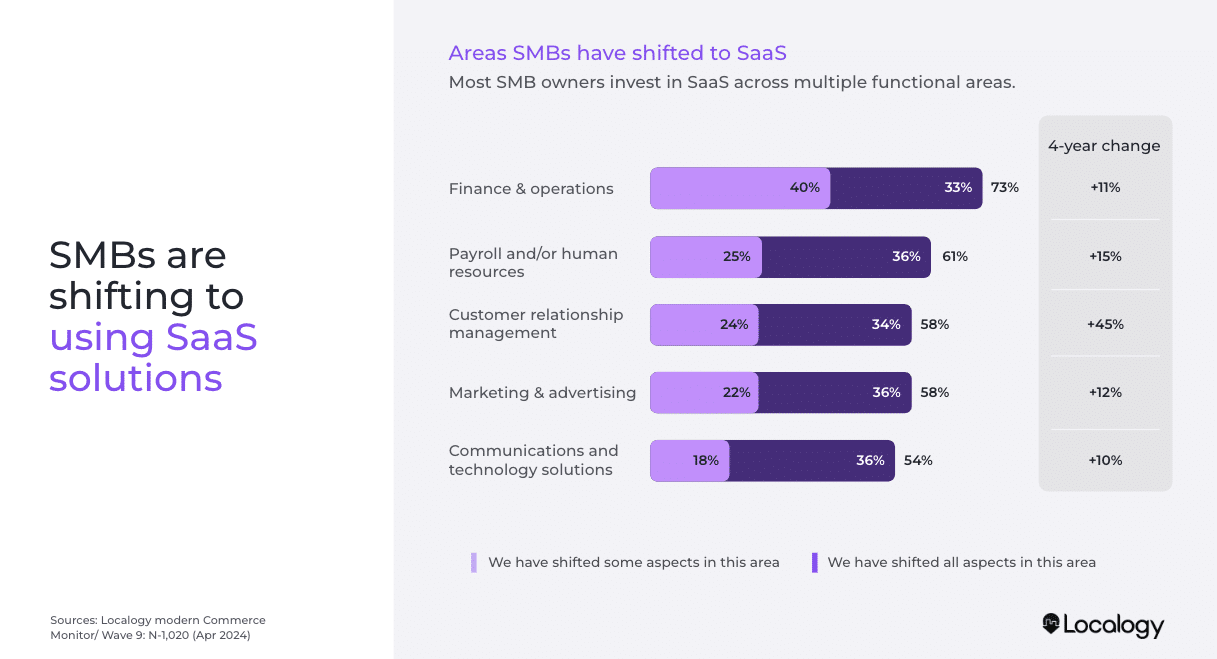
Going one level deeper, what specific areas of SaaS are most opportune? In other words, in what functional areas do SMBs show the most demand for software? The good news is that it’s strong across the board, with robust adoption from finance & operations to CRM to advertising & marketing.
But the most opportunity may lie in the categories that have less adoption. There, we see greater headroom for growth. For example, in advertising & marketing, MCM indicates that SMB adoption is at 58 percent – a nice sweet spot between robust adoption and meaningful headroom for further growth.
One-Stop-Shop
Switching gears, how are SMBs getting their software? One key question that continues to come up is if SMBs want one provider to bring them all of the above functions, or if they prefer to work with a series of best-of-breed vendors. Beyond what they want, a more important metric is what they’re actually doing.
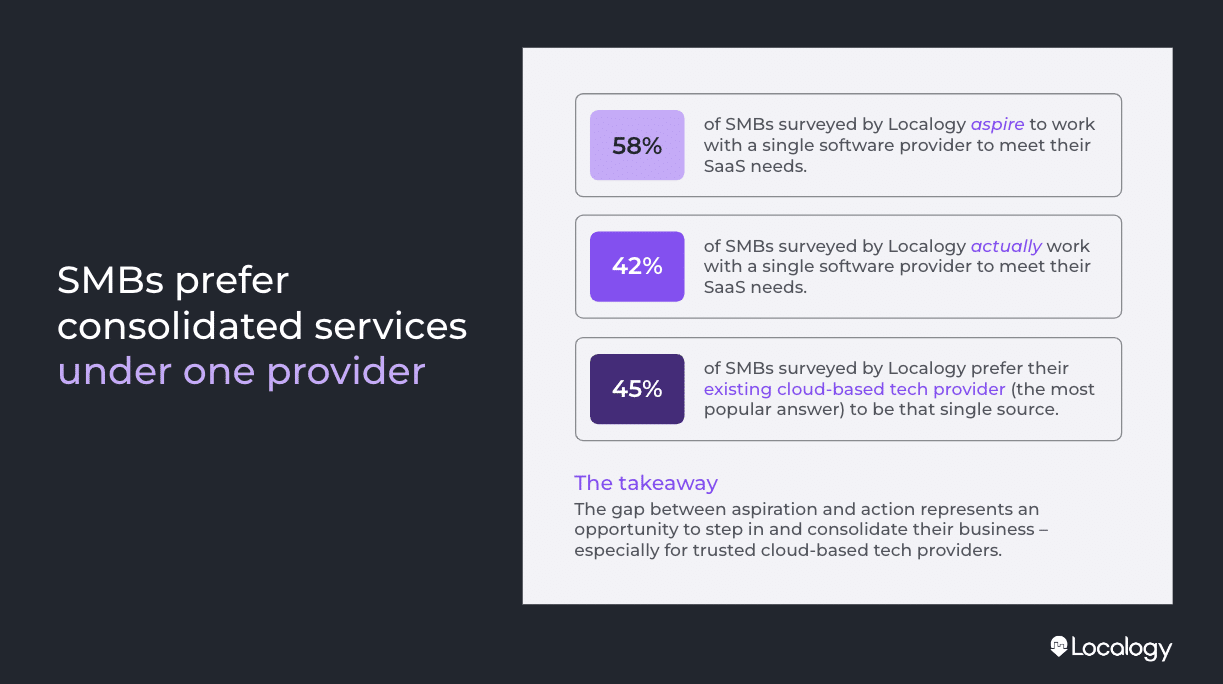
Breaking that down, 58 percent of SMBs tell us that they aspire to work with one software vendor for all their SaaS needs. However, only 42 percent have actually taken the steps to consolodate software vendors. 45 percent report that their preferred “one-stop” vendor is their existing cloud tech provider.
The biggest takeaway here is that there’s an opportunity that lies within the gap between aspiration and action. There are still several SMBs that want to consolodate vendors, but haven’t yet. Whoever can consolodate their business can form deep relationships that carry strong retention and ARPU metrics.
Hopes & Dreams
Of course, it’s easier said than done to get SMBs to ditch their other vendors and sign up with a one-stop-shop offering. But the signs are clear that it’s what they want. From there, selling SBMs into a SaaS bundle is a matter of addressing hopes & dreams that they communicate throughout the State of SMB research.
Meanwhile, as all of the above just scratches the surface, you can request to access the full State of SMB Report. Please let us know how we can support your narratives through data and research.