

There’s an ongoing rallying cry among tech & media pundits that ad-supported media is dead. This is propelled by several factors including the privacy era, which has handicapped the data collection practices that fueled the past decade’s surges in ad tech. There’s also a bit of schadenfreude.
This applies to the printed word, which has experienced its share of business-model shakeups in the past two decades, as well as the broader entertainment category. Altogether, we’re talking about everything from news paywalls to substack to streaming services to premium versions of social apps.
Meanwhile, we’re also seeing effects of the cord-cutting movement of the past 15 years. As the cable bundle is abandoned in favor of a la carte apps, there’s a sort of re-bundling where consumers cobble together a customized OTT array of Netflix/Max/Prime/Hulu/Peacock/YouTubeTV and others.
But though this approach offers choice and customization – versus 200 cable channels you don’t care about – it can get expensive. The all-in cost of all those streaming apps listed above can approach or even exceed the dreaded cable bill that incited last decade’s cord-cutting movement in the first place.
Habits Are Hard to Break
Adding up all of the above, the question is if the paid content movement has gone overboard. Though tech punditry loves to talk about how consumers are fed up with data misuse in ad targeting – and that they’d rather pay with dollars rather than data – there’s evidence that this is a luxury belief.
Put differently, real consumers can’t always pay for all those subscriptions and many don’t mind sharing their data for free content with a side of targeted ads. Another factor often ignored in all that punditry is that ad support is the way consumers are accustomed to getting content… and habits are hard to break.
To put some numbers behind these claims, we continue to see data from media consumption trackers like Pew, signaling that the content-revolution punditry isn’t aligned with actual consumer preferences. They care more about saving money, as opposed to all the virtue signaling around data integrity.
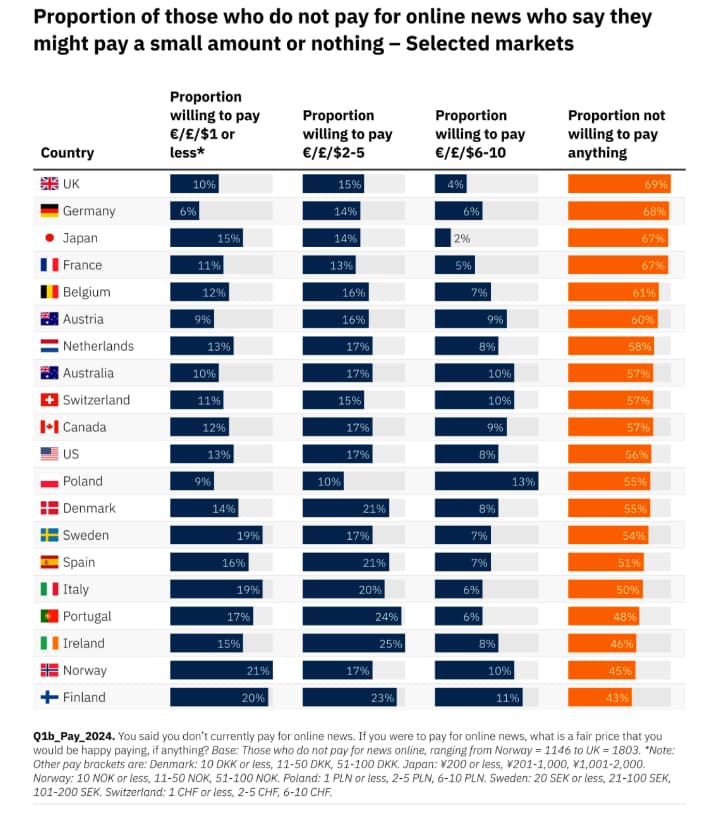
The latest piece of evidence to cross our desks comes from Nieman Lab. Its consumer survey research indicates that 41 percent of global news consumers pay less than full price for subscriptions. Moreover, 67 percent of consumers aren’t willing to pay anything for news content, which varies by country.
Unring the Bell
There are a few takeaways from these findings. The most obvious one is that it’s a deflating sentiment for the news industry that such a large share of users aren’t willing to pay for the content in any way. This could be a residual effect of the ad-tech era… they’ve been conditioned to think that news is free.
That gets back to the premise that a majority of consumers are okay with paying with data rather than dollars, despite claims to the contrary. It also gets back to a point made earlier about consumer habits. After getting their news for free for so many years, it’s hard to unring that bell, or resurrect that paywall.
Another finding is buried within the share of consumers who don’t pay full price. This suggests lots of discounting underway, which is likewise a discouraging signal for news media as a whole. It suggests that several publishers find themselves in the position to have to discount, which isn’t a great sign.
Of course, all the above speaks on aggregate levels. There are successful paid-content programs out there, such as the New York Times and Wall Street Journal. And publishers like Torstar are managing all of this disruption, and doing so deftly. We’ll keep a close eye on results and best practices.