
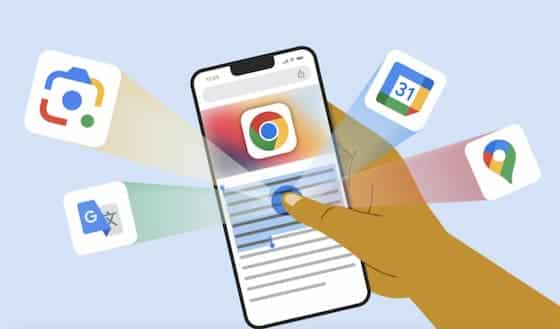
Google has taken the latest step in its ongoing efforts to make visual search a thing. It’s integrating Google Lens deeper into iOS via the Chrome browser. This could have a meaningful impact, considering the scale that can be reached through the combined reach of iOS and Chrome.
As background, visual search – unlike the similarly-named offshoot of SEO to gain traffic via image optimization – is when you use your camera as a search input. Rather than type/tap queries in a search box, you point your phone at items to identify them. It’s fitting to subjects like fashion and food.
Google’s bid for visual search is Google Lens, and its competitors include Snap Scan and Pinterest Lens. Google is intent on cultivating visual search because, like voice search, it can boost query volume by expanding the surface area of search. It can also help future-proof its core search business.
These motivating factors have pushed Google to increasingly offer ways for users to find and ease into Google Lens. For example, past moves to expose Google Lens include planting it next to the voice search icon on Google’s homepage on desktop and mobile, which is a highly-exposed place to put it.
Break Free
With that historical backdrop, this week’s move likewise pushes Google Lens more front & center in well-trafficked places. As noted, it will be integrated deeper into iOS, with Chrome as its vessel. Specifically, you can jump from the browser to the camera to launch visual searches with fewer steps.
The way this plays out is that a Google Lens icon will be planted in the Chrome address bar. Pressing it opens the camera where you can take new pictures or query images in your camera roll. Either way, Lens goes to work quickly to identify objects in a given photo, or launch searches for similar items.
Before this move, users could activate Lens within Chrome in various ways. As noted, the Google Lens icon sits front & center next to the voice search button on the Google homepage. Users can also long-press any image on the web to search related images and topics (basically a reverse-image search).
The difference with this week’s update is that Lens (via Chrome) is more integrated with the camera. This could help it break free from the web to query the physical world around you. We’re talking moments of discovery or serendipity in educational, travel, or local commerce contexts.
Piggybacking on Gen-Z
Going deeper into potential Google Lens use cases, the physical world (as opposed to the web) is where the technology will shine. As noted, this includes fashion, food travel, education, and local discovery. The latter is all about identifying storefronts and diving deeper into things like menus & reviews.
That local discovery use case is obviously relevant to the world of local search and SEO. We’ve even speculated that visual search could engender a new flavor, or offshoot, of local SEO where visual information is optimized like text is today. Image optimization happens today but for different reasons.
Of course, the impact of these moves, and of our hypothesized SEO offshoot, depend on one key factor: if visual search gains traction. Will it be a slice of search query volume (like voice search), or a more formidable search input that resonates with the camera-native and spending-power-strong Gen Z?
This is the wild card that we’ll have to watch. Google Lens hasn’t caught as we thought it would, and maybe that’s a key demand signal. But if it starts to accelerate on the backs of Gen-Z affinities, it could carry strong commercial intent, given the lean-forward act of identifying things visually.