The AI race is on. We haven’t seen a technology – and the hype surrounding it – inflect this quickly in a long time. You could argue that the metaverse hype cycle was similar… but the big difference with AI is that it actually exists today. Though there might be some hyperbole, it’s not all vapor.
A cross-section of this activity could be seen in the past week alone. Both Google (Marketing Live) and Microsoft (Build) held major events where AI took center stage. And this follows soon after the AI fest that was Google I/O. Yes, there’s enough AI action to subsume two events in as many weeks.
So to document the state of big tech’s AI investment, innovation, and integration, we’re bringing you this two-part series on the biggest takeaways from Google and Microsoft events. We’ll start here in Part I with Google’s Marketing Live, followed by Part II on Microsoft’s Build conference. Stay tuned for that…
Business in the Front
Jumping right into Google’s Event, it announced generative search results among other things. These involve search results that are customized on the fly, based on a given search query. For example, meta descriptions are personalized to address a search query, generated from the contents of a given page.
This builds on Google’s existing automatically generated assets (ACA), now with a generative AI twist. Before ACA, search results mostly consisted of relatively static elements. These include images, URLs, and a meta description, which publishers could manually optimize to boost traffic.
These elements could also be left alone, in which case Google would construct them for you in automated ways. But they were still relatively static. Post ACA (and now with more generative AI) those search results become more fluid. They can change dynamically on a query-by-query basis.
Similarly, Google is bringing generative AI to the back end. This attempts to streamline search ad campaigns by automating some aspects. For example, advertisers can specify the page they want to drive traffic to, and Google will use AI to generate keywords, headlines, images, and descriptions.
Just the Beginning
Elsewhere at the Marketing Live event, Google launched Product Studio. The theme there is similar to the above in that Google is offering generative AI for marketers to create product images through text prompts, including custom backgrounds. This will be particularly relevant for Google Shopping.
The idea is to not only lower barriers for marketers to run search ad campaigns (and thus boost ad spend), but to be more effective. Google reports that product listings with more than one image see 76 percent greater impressions and 32 percent more clicks. Generative AI is the bridge to that outcome.
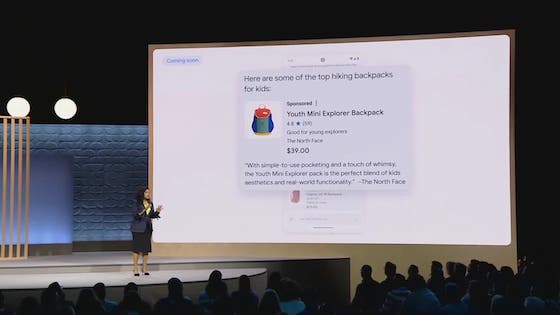
Lastly, as Microsoft has done with ChatGPT results in Bing, Google is starting to experiment with integrating ads in its AI chatbot results. This includes Search and Shopping ads that run above and below chatbot answers. We knew this was coming to offset any AI-driven declines in paid SERP ad inventory.
In that light, all the above not only advances Google’s AI efforts but points to how it will monetize. Though it can be seen as cannibalistic, AI will end up serving Google. As we’ve argued, it will figure out the monetization piece through several points of integration. And we’re now seeing just the beginning.
Stay tuned for Part II, when we’ll provide similar takeaways from Microsoft Build…