Next year I will turn 60. I know, yikes. So now whenever I see the phrase “60 is the new 40” I feel energized. Then I remember that it isn’t even close to being true. You may as well say “30 is the new 10”. Thankfully no one does.
So I react skeptically to any similar assertion. Hence when I read some headlines this morning featuring the phrase “Thursday is the new Monday” the eye-roll reflex kicked in.
So “Thursday is the new Monday”. Really? Says who? For me, Thursday has always been Friday giving us a head fake.
Apparently, the origin of this dubious assertion is new data on workers’ preferred days of the week to work at home vs. coming to the office. Quantifying the new normal of the hybrid workplace was inevitable, after all.
Office or Home? Depends on the Day
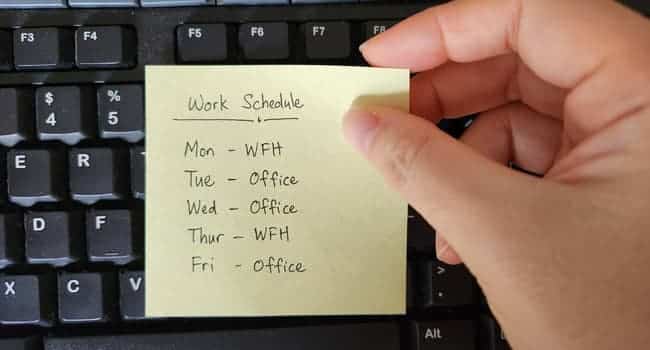
This week a story from Bloomberg, picked up by various business publications, cites data from WFH Research that found Friday is the most popular day to work from home. Thursday was a close second for the favorite WFH day of the week. Monday came in third. The same research found that Wednesday was the preferred day to go to the office and fulfill that facetime-with-the-boss obligation.
Ok. So, again, why is Thursday the new Monday? The Bloomberg piece suggests this is because working from home on Thursday bucks the preferences of many companies adopting the hybrid work model to have their teams in the office from Tuesday through Thursday while working in their pajamas on Monday and Friday.
Hybrid Work — The Ultimate Compromise
OK, I still don’t really get why “Thursday is the new Monday”. This still just sounds like more media phrase-making along the lines of “Quiet Quitting.” Remember that one?
What does seem to be the case after years of tinkering with ideas like remote work, WFH, digital nomadism, and so on, is that, for knowledge workers at least, the time of day or day of the week doesn’t matter very much. In these working models, people work when they feel most productive (early morning, late at night, whenever). Or they work when their virtual presence is required (on video meetings, for example). And, of course, they work when the work is due.
The tension is real between employers who want everyone in the office all the time and workers who never want to leave home. And for many, hybrid work has become a compromise that no one loves but everyone can live with.
The Hybrid Work Space
Hybrid work also seems to be creating an industry to support itself. As we have covered previously, Yext founder Howard Lerman has launched a company called Ro.am that has attracted a lot of capital (and attention) to build what is essentially an operating system for the hybrid workplace.
Lerman’s startup insight was that the hybrid workplace — which inherently means a mix of in-office and at-home work — needs a tool to facilitate serendipitous 1:1 interactions. Just as the best creative workplaces have always done.
The video conferencing platform Zoom of course probably already thought of itself as that OS for hybrid work. But Lerman has pretty vigorously taken Zoom on in the course of promoting Ro.am.
“The big problem with Zoom,” Lerman told CNBC’s Andrew Ross-Sorkin, “is that things that should take two people five minutes to do today are now scheduled for five people on a 30-minute call next week.”
Ro.am’s response? The average length of the impromptu meetings on Ro.am is 8:34, according to Lerman. It’s one of the new platform’s key selling points — an efficient hybrid workplace.
For its part, Zoom has recently added features that seem designed to make the platform a more robust hybrid work OS. At the sixth annual Zoomtopia in November, Zoom announced a number of hybrid-friendly features, including mail and calendar integrations, virtual co-working (Zoom Spots), collaboration tools, and more.
The future of work will be a key topic at the Localogy 23 conference, April 17-19, 2023, in Coronado, California. And Lerman will be a speaker.