Shoppable content continues to come out of the woodwork. As we’ve been tracking for the past several months, there’s an accelerated pace of product rollouts that feature shoppability. For those unfamiliar, this is product-based content – often in social feeds – that has direct transactional functionality.
We’re talking buy buttons in everything from Instagram Stories to YouTube videos. This may seem like an obvious evolution to reduce friction and compress the shopping funnel, but it follows years of convoluted click streams, given the fragmented nature of web properties and app-based walled gardens.
Of course, the rise of the social “buy” button has been underway for the past decade but, like many other flavors of digital transformation, it was accelerated in the eCommerce-heavy Covid era. And though that propellant itself has receded, the shoppability trend looks poised to continue growing.
Survival Imperative
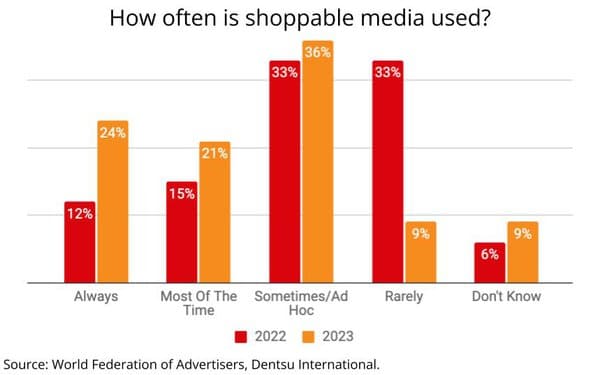
The latest evidence of shoppability’s rise comes from new survey data from the World Federation of Advertisers (WFA) and Dentsu International. Among other findings, it indicates that the frequency of shoppable content across digital media will jump to “always” or “most of the time” (see chart below).
Put another way, it will become more ubiquitous. Or at least that’s the expectation of survey respondents, which in this case are brand marketers. Though these sentiments are aspirational, as it often goes with survey research, these brands have a reliable vantage point on consumer behavior.
And if they’re correct, shoppability could accelerate. As history shows (think: digital photos), consumers get acclimated to a given tech integration to the point that it becomes an expectation. Then it correspondingly becomes a survival imperative for brands and retailers. Shoppability could be next.
But for now, most survey respondents report that shoppability is currently in a “trial” phase in terms of their own product development. Synthesizing all of the above, there appears to be an opportunity gap between the consumer demand that brands and retailers see, and the current features they offer.
First Party
Beyond Covid and the ongoing compression of the digital purchase funnel, another key trend will accelerate shoppability: privacy. As we discussed at Localogy 2022, privacy reform is upending the worlds of advertising and eCommerce, including budget shifts to less targeted media like CTV.
But another key outcome of privacy reform is greater value placed on first-party data. Because most privacy reform locks down the selling and sharing of third-party data, self-contained networks that utilize first-party data (think Amazon) are in a prime position for the next media & marketing era.
Tying this all back to shoppability, the value of having robust first-party data compels more self-contained shopping flows. In other words, a core tenet of shoppability is completing an entire transaction under your own roof. And that, as a byproduct, produces lots of valuable first-party data.
We’ll continue tracking ongoing developments in the shoppability trend, including YouTube’s latest integration of shoppable content. If WFA and Dentsu’s report is any indication, we’ll see a shoppability blitz across social, search and other digital channels to make all things transactional.