
While Snap, Meta, Pinterest, Wayfair, IKEA, and several others lean into AR, the king of online shopping has been slow to join the party. Amazon’s AR efforts so far have included a few furniture and appliance-based trials, which is less than expected given AR’s proven ROI in product marketing.
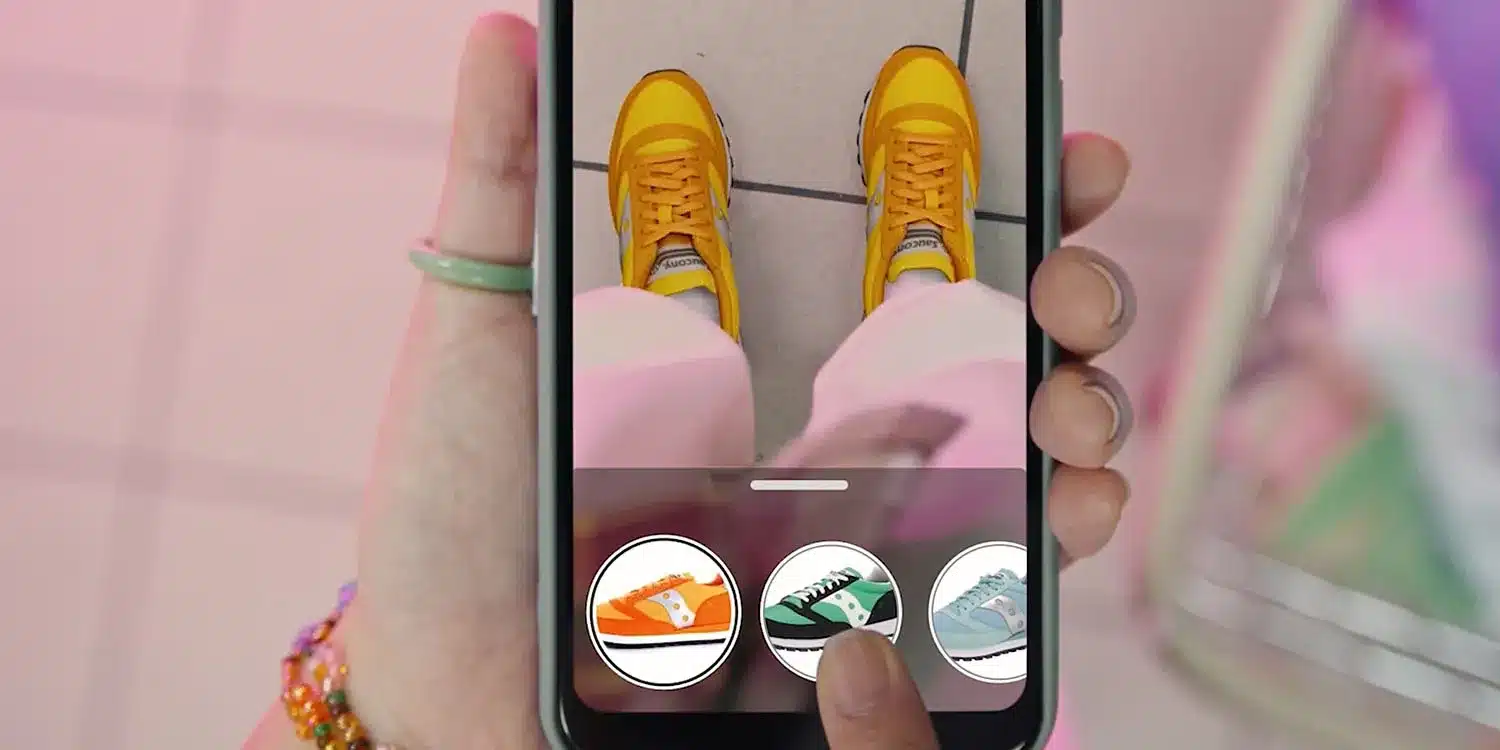
This all took a different direction this week when Amazon announced “Virtual Try-on For Shoes.” Available through a new button on supported product pages on iOS, consumers can – as advertised – digitally try on shoes. The idea is to get a better sense of fit and style, and thus buyer confidence.
Dimensionally Accurate
From a UX perspective, after tapping the try-on button and activating the camera, consumers point down at their feet (see header image) to activate the AR try-on. Under the digital shoe rendering in the phone’s viewfinder is a carousel to dynamically swipe through colors without exiting.
As background for those unfamiliar with the technicalities of AR, this utilizes a key AR principle known as occlusion – not only overlaying digital content but doing so in dimensionally-accurate ways (in this case hiding your feet). This is compared with rudimentary AR like Pokemon Go which has “floating stickers.”
The new feature also gives users an easy way to snap a photo of the try-on and share to social media in the same product flow. This is a smart move by Amazon in that it adds an additional viral kick to propel the new feature. And this is a context that’s naturally shareable, especially among sneakerheads.
For the same reason, shoes are a good candidate for AR-try-ons. They have a combination of nuance in fit & style, and high consideration. This is where an extra confidence boost from dimensional visualization can increase conversions… and decrease a major eCommerce pain point: returns.

Evolutionary Steps
Besides shoes, AR is a hit for furniture because of item bulk. It’s also been popular for cosmetics, especially in the Covid era which precluded high-touch retail makeup try-ons. This is a key lesson: AR isn’t a silver bullet. its application to product marketing works better in some categories than others.
In fact, this principle can be broadened to explain AR’s overall adoption arc over the past few years. Though it was lauded in its circa-2017 hype cycle to be a looming technology that will change everything, it has really only proven valuable in a few places – brand marketing being one of them.
But that’s not to say the technology is useless. It’s finding its place in meaningful ways in other areas like enterprise productivity and visual search. Beyond the technology’s organic fit in specific areas, another factor is cultural acclimation… which always takes time for large-scale behavioral shifts.
This is all to say that the smartest players seem to be aligning themselves accurately with that gradual AR adoption curve. That gets back to Amazon and how it has slow-walked AR efforts. The same can be said for Apple’s gradual AR glasses development. We’ll keep tracking the evolutionary steps.
Editor’s note: For those interested in this topic, check out Localogy’s upcoming Place Conference which will be all about adding digital dimension to the physical world…