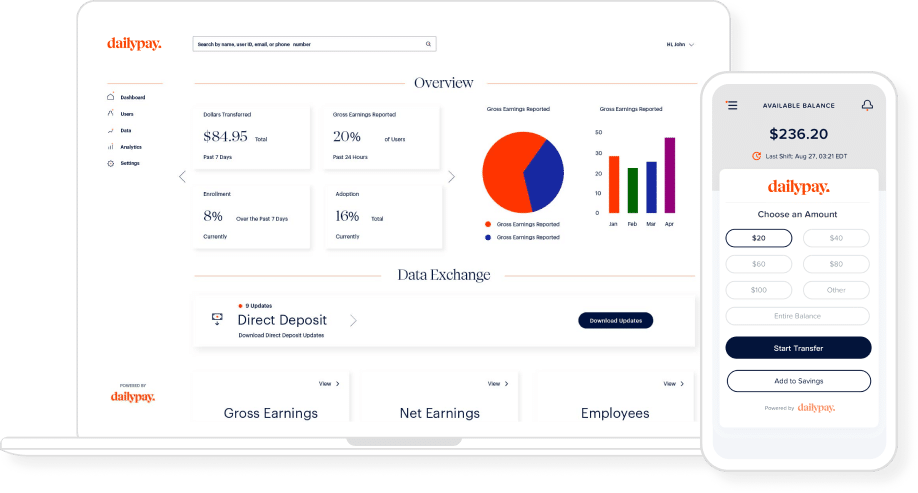
We’ve written in the past about earned wage access, also called on-demand pay. This is a growing branch of the fintech industry that gives workers access to wages they’ve already earned but before their regular payday.
New York-based DailyPay, a key player in this emerging space just raised a $300 million revolving credit facility from Barclays. This is a pretty big deal. After all, having access to a pile of cash is the lifeblood of an earned wage access platform.
EWA in many ways resembles buy now, pay later. The latter payments model fronts retailers the full purchase amount and then collects repayment in installments from the consumer. Usually, the payments are interest-free and the merchants pay a fee for the service. But models vary. One common thread for any BNPL platform is that it needs to be well-capitalized.
The same goes for earned-wage access providers. Similar to BNPL, the EWA platforms front a portion of a worker’s wages and then collect it at payday. This is a presumably low-risk endeavor since the employee has already worked the hours. As long as the employer makes payroll, presumably, the money is there to repay the advance.
DailyPay’s CEO acknowledges that having cash on hand is essential to compete for relationships with big enterprise players with large payrolls.
“A fortress balance sheet is essential to be a leading company in on-demand pay,” said DailyPay’s Co-founder and CEO Jason Lee. “This credit facility will allow us to work with more of the largest employers in the country to offer on-demand pay to their employees.”
DailyPay was founded in 2015 by Lee and Robert Law. Since its founding, the company has raised $814 million, in a combination of debt and equity. DailyPay works with large employers that include Dollar Tree, Berkshire Hathaway, and Adecco.
Competitive Field
The company operates in a competitive space with rivals that include Clair, PayActiv, HoneyBee, True Connect, and Salary Finance. To name just a few.
Some EWA platforms specialize in specific industries. Fuego for example offers EWA for hospitality employees who work for companies using the HotSchedules hospitality scheduling app.
We’re also seeing payroll and HR companies offer this as a feature.
The payroll company Gusto launched FlexiblePay all the way back in 2018. The feature lets employees define their pay schedule. This assumes their employers activate this feature in their payroll application. And Square (now Block) launched Instant Payments in 2020 as part of its payroll solution. And ADP offers EWA through its Wisely financial wellness app.
Is It Really Good for Workers?
Also like BNPL, earned wage access has its skeptics and critics. For example, the solutions are not free. Typically, employees pay a small fee for early access to wages. Or, they are forced to use a provider’s card in order to get access to the solutions. Rarely are there no strings.
The counterargument is that workers would otherwise turn to usurious solutions like payday loans. So EWA, while not perfect, is a much better alternative to high-interest loans, at least.
A broader critique of EWA is that it shines a light on the fact that so many employees live paycheck to paycheck. EWA doesn’t solve income inequality. It just rearranges the deck chairs. Still, when the light bill is due, workers are no doubt grateful to have this option.
Critiques aside, the wind seems to be at EWA’s back. In an era where there is in intense competition for workers, this will likely soon become table stakes, if it isn’t already. It’s not hard to imagine a worker, faced with the choice between two $15 an hour jobs, will go with the one that lets them decide when they get paid.