Getting paid faster is the new getting paid on time. And we are seeing evidence of it everywhere.
Uber drivers, for example, no longer have to wait until the end of the week to cash out their earnings. They just hit an instant pay button and presto, money lands in their account (less a small fee).
Meanwhile, an entire subset of the fintech industry called earned wage access now makes it possible for wage earners to take paycheck advances at fees well below what they would fork over to payday lenders.
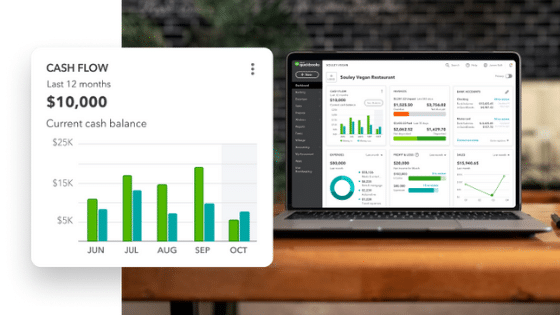
Intuit, which owns the QuickBooks accounting software platform, has clearly read these tea leaves. The company recently announced two fintech add-ons that line up with the instant payments trend.
QuickBooks Get Paid Upfront lets eligible QuickBooks Online customers get paid immediately outstanding invoices. QuickBooks Early Pay is the company’s entry into the earned wage access space. The company charges customers a 3% flat fee per financed invoice. QuickBooks says the invoices are financed interest-free for the first 30 days.
Finding $400
Early Pay is designed to help small business employees cover expenses that can’t wait until payday. In its announcement, QuickBooks note an often-cited statistic about America’s widespread financial desperation.
“Nearly 40 percent of Americans say they would struggle to pay an unexpected $400 emergency expense,” the company said. Notably, QuickBooks says it is offering this service for free to employers. Most companies offering this service charge a fee. And employers can either absorb the fee.
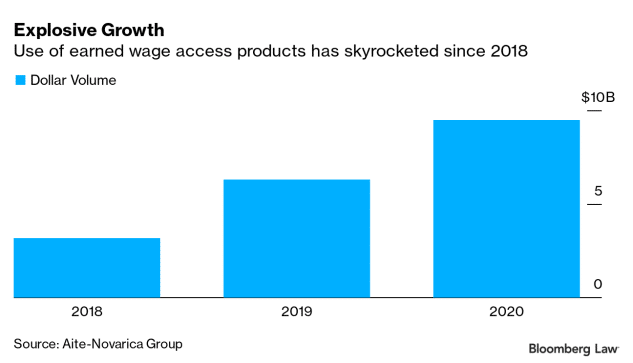
Or they can pass it on to their employees. This decision may reflect the fact that EWA products are coming under some scrutiny from regulators trying to determine if they should be regulated as a credit or lending product. They are also increasingly popular, as the following chart (borrowed from Bloomberg) shows.
There are tradeoffs on both sides of these features. Typically the platform, in this case, QuickBooks, either fronts the money or releases it sooner than it ordinarily would. But as noted, they collect fees for convenience and to offset any risk.
In this way, these features bear some similarity to buy now, pay later. In that model, BNPL platforms give merchants money upfront for purchases (online or in-store). And then they collect it in installments from the consumer. Most of the BNPL platforms then charge the merchant a fee for the service. Others, like Affirm, collect interest from the consumer.
Do Earned Wage Access Tools Make Workers More Productive?
Riding the Trend
Intuit’s EVP running the QuickBooks Small Business and Self-Employed Group acknowledged the new products were responsive to trends.
“Faster access to money is a universal need among small businesses and the people they employ,” said Intuit’s Alex Chriss.
“By making financial services available across the QuickBooks platform when and how small business owners and their employees need them most, we unlock even more benefit and value for our customers and greater opportunities for them to achieve prosperity.”
Despite some controversy over their use, we expect having some kind of EWA feature will be table stakes for most employers moving forward. Particularly in an era of acute labor shortages, the ability to pay early may be almost as important as paying higher wages. Emphasis on almost.