
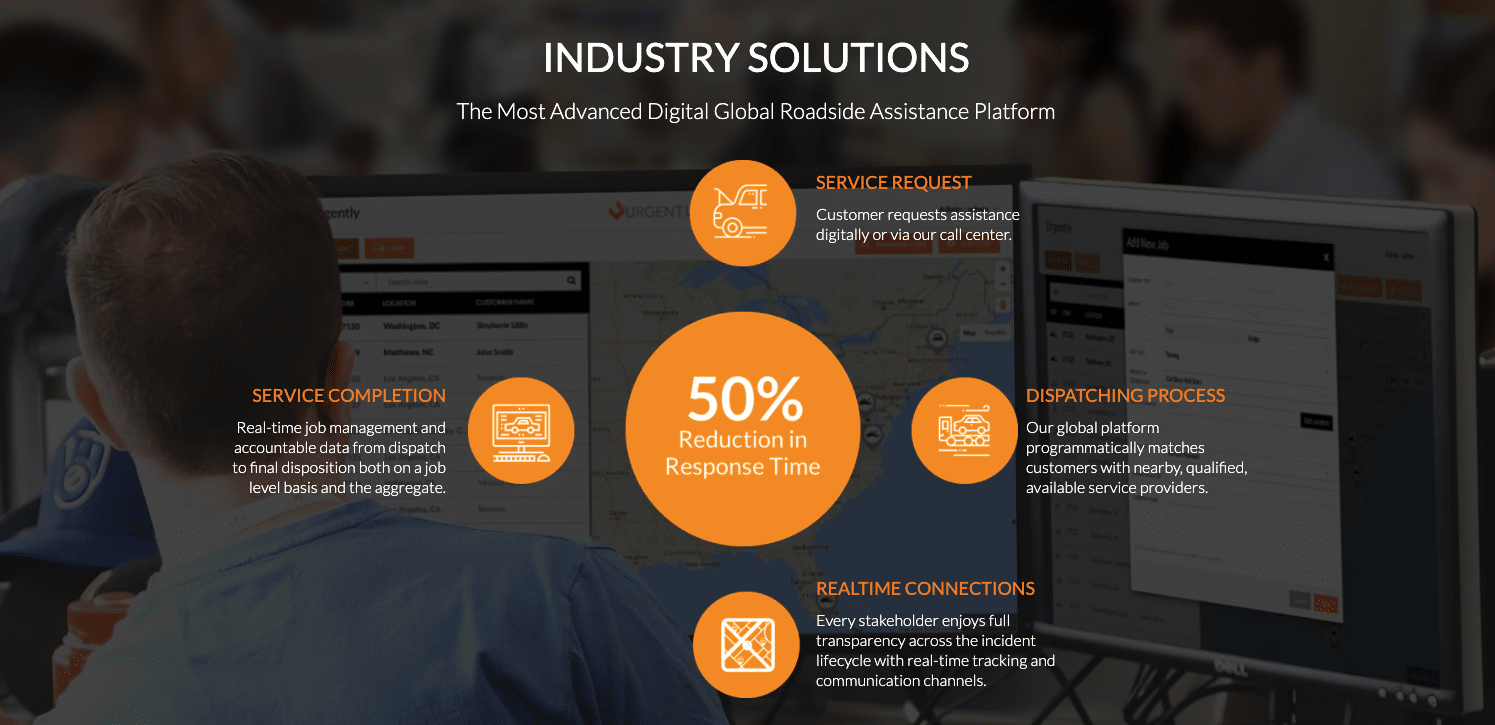
The digital roadside assistance platform Urgently claims it can reduce response times for roadside emergencies by as much as 50%. Today the company announced a debt financing round of up to $75 million debt round that fund sales and product initiatives until the company goes out for a new equity round next year.
“The high-level plan is to increase investment in product and technology, especially machine learning and data science, to build new products for our OEM, insurance, and fleet partners,” Urgently President Matt Booth told Localogy Insider.
“The funding will allow us to bring on many new partners in 2022. We have grown the business substantially. Additionally, this funding allows us to enter key markets like subscription (direct to consumer) and expand our EV/Connected Vehicle SaaS solutions.”
The debt round comes from funds managed by Highbridge Capital Management LLC, Onex Credit, and Whitebox Advisors. On top of the $74 million debt round, existing nelder Structural Capital has extended its existing debt facility with Urgently to $17.45 million.
Rapid Growth
Current CEO Chris Spanos and five others founded Urgently in 2013. The company set out to disrupt the roadside assistance business, which old line players like AAA have long dominated.
Since its launch, Urgently has raised $39.7 million. In the meantime, it has evolved its business to focus on partnering with large organizations that already shell out substantial sums for roadside assistance. These include automotive manufacturers, insurance companies, telematics providers, and other auto-focused vericals.
Urgently has done well over the past year, and hopes the new funding will help it keep up the momentum. Urgently has grown annual service requests from 470,000 in 2019 to an estimated 1.2 million in 2021. Matt told us revenue grew by 300 percent over the same time period.
Urgently currently has over 50 blue chip operating partners supported by a vast 80,000+ connected North American Service Provider network.
Three Key Disruptions
While we had Matt, we wanted to hear a little more about what trends Urgently sees on the horizon. He told us Urgently see three key disruptions taking place the global automotive space.
“First, there’s the global automotive and repair market at $828 billion. Historically, consumers have their vehicles serviced at repair shop. What we have seen is an increase in mobile repair, or repair that comes to you. This requires the combination of a service fleet and software to enable third parties like dealerships and other mobile repair companies to extend their service footprint,” Matt told us.
“Second, there’s the $7 billion U.S. consumer roadside subscription market. AAA makes up 90% of the market with 60 million subscribers. The next largest competitor has roughly 3 million.”
The third piece, according to Booth, involves the connected car. “McKinsey estimates that the future Connected Car market will be $250 billion to $400 billion, Matt said. “These will be new services driven off over-the-air communications from the vehicle to service networks (like Urgently) and the vehicle owner.”
Driven by Data
Subscription is a common feature across these areas of disruption. Instead of a subscription to tow your car if it breaks down, you buy a subscription to give you a heads up to avoid mechanical emergices in the first place.
“Historically if you worried about your car breaking down you bought AAA,” Matt said. “In the future, you will proactively send a signal to companies like Urgently. For example, let’s say your battery is getting low. And in a few weeks it will not charge. Urgently will algorithmically diagnose the fault codes and match the problem automatically with the service network. This will be a new kind of proactive assistance. You will not be inconvenienced by a breakdown. And, where possible, you’ll be warned ahead of time of potential problems.”
None of this disruption takes place without piles data and machine learning to make sense of it all.
“All of these markets are transforming around data and data transmissions,” Matt told us. “This is why machine learning and data science are so critical in stitching together subscription services around data/notifications.”