Look out Google and Facebook… Amazon has its eyes on your lunch. Amazon eating up digital advertising market share isn’t a new phenomenon as the company has been painted as a “duopoly” killer for the past half-decade. But the threat is increasingly real as Amazon ratchets up ad efforts.
The latest evidence comes in today’s WSJ article (subscription req’d) that cites eMarketer estimates that Amazon has broken the 10 percent barrier. It’s estimated to have brought in $15.73 billion in ad revenue for full-year 2020, which is up 52 percent year-over-year. This inches Amazon past the 10 percent mark.
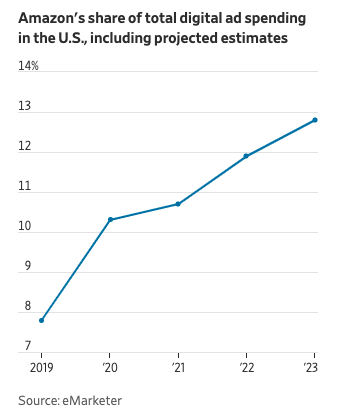
Specifically, if eMarketer’s estimates are correct, Amazon’s 2020 ad revenues put it at 10.3 percent of U.S. digital ad spend. To be clear, what we’re talking about here is sellers that amplify their exposure within Amazon by buying into its various sponsored placement offers. As we’ve reported, 73 percent of sellers do so.
The Bigger Question
Perhaps important than Amazon’s passing of a symmetrical milestone is its momentum in doing so. Its market share is up from 7.8 percent in 2019, signaling rapid growth that could continue. This forward-looking speculation is the bigger question: To what degree will Amazon continue to nip at the duopoly’s heels?
eMarketer believes Amazon will indeed continue to rapidly gain ground on Google and Facebook. Currently, Amazon’s 10.3 percent market share in 2002 compares to Google’s 28.9 percent and Facebook’s 25.2 percent. But again, future outcomes could be signaled by Amazon’s current momentum.
To put some predictions behind that, eMarketer projects Amazon to reach 10.7 percent of U.S. digital ad spend this year, growing to 11.9 percent next year and 12.8 percent in 2023. The firm also predicts that much of this growth will cut into Google’s market share, while Facebook remains fairly flat.
This is mostly because 90 percent of Amazon’s ad revenue is from search formats, such as sponsored results in Amazon search. This ad budget adjacency, plus privacy reform on the broader web, could push advertisers into the arms of strong first-party networks. It doesn’t get much bigger than Amazon on that measure.
Long Tail
Stepping back, Amazon’s milestone isn’t surprising, given its core revenue growth in 2020 — a function of of e-Commerce’s Covid-advantaged positioning in general. In other words, given the correlation between sellers and ad spend cited above, it’s logical that Amazon’s e-Commerce growth stimulates ad revenue.
Going deeper on this correlation, one orbiting factor that could impact things is the continued growth of the third-party Amazon marketplace. Known as the FBA (fulfilled by Amazon) network, it consists mostly of SMBs who want to gain additional distribution scale (albeit compressed margins) through Amazon.
The FBA universe isn’t necessarily new, and is one way that Amazon has grown so rapidly over the past several years. But one thing that is new is the efforts to federate FBA sellers under one umbrella. Companies like Thrasio and JungleScout are doing so by establishing operational standards and economies of scale.
This could be one more wild card in Amazon’s overall growth. And as these FBA networks grow, so may their standardized tools and practices for amplifying sales through Amazon advertising. Along with brand spending on advertising, this SMB long tail could fuel Amazon’s continued challenge to the duopoly.