
I’ve written recently about “acceleration” and how COVID is pushing trends that were well underway several years forward. In a post last week, I alluded to how the movement to remote work is threatening a longstanding institution — the big expense account enterprise sales exec.
We quoted a master of this artform, Vendasta EVP Sales George Leith, expressing the following view:
“We are about to announce a partnership that was started in June that is the biggest relationship that we have ever signed, and we did it virtually. Because we had to. Now, when we say we might start traveling again, [our CFO] says, ‘But you’re setting records without that investment.’ I think that is happening in a lot of organizations.”
This anecdotal datapoint led me to look around for some data that tells the full story of how COVID is changing how businesses sell to other businesses. I came across this McKinsey report, which is about a month old. That can seem like a century these days, but the report’s data and observations are still relevant.
McKinsey surveyed 3,600 decisionmakers in 11 countries to find out how the B2B sales process is changing.
Customers Want Virtual Interactions
The study’s findings are compelling and support the acceleration narrative. For example, the report finds that COVID seems to be turning many of us into homebodies and introverts. Across all of the markets surveyed, twice as many preferred remote sales meetings over face to face. The figures were 3X in Spain and the UK.
Another data point that jumped out is how the pandemic has driven up preferences for self-service sales. For example, the study found a 30% rise in preference for making B2B purchases via a mobile app. And there was a 250% rise in mobile app ordering since the pandemic hit.
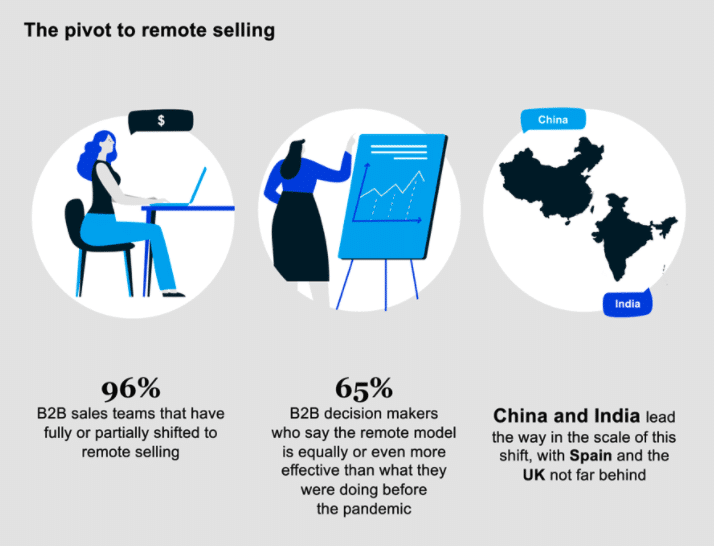
Finally, companies told McKinsey that remote selling is here to stay, with 96% of B2B sales teams making the shift to remote, if only partially. More interesting is the 65% who say remote sales are as good or better than the pre-pandemic model, whatever it was. This is consistent with what we are hearing from many of the companies we’ve talked to about handling sales during the pandemic.
The Dreaded New Normal
The McKinsey report offers more evidence that some trends we have been predicting are being brought closer to reality by the pandemic. My Localogy colleague Neal Polachek has been a long-standing advocate for “buy it yourself,” for example. This is a process in which well-informed B2B buyers make the initial product purchase online. Actual salespeople still have a role in this model. But it is but more in after-sales service, support, and upsell than in the initial customer acquisition. The McKinsey data suggests that post-pandemic, more B2B buyers will insist on doing business this way.
More from Localogy Insider