
This is the latest in Localogy’s Skate To Where the Puck is Going series. Running semi-weekly, it examines the moves and motivations of tech giants as leading indicators for where markets are moving. Check out the entire series here, and its origin here.
By now, you’ve likely heard about Apple and Google’s contact tracing collaboration. It’s historic in that joint-efforts between Apple and Google are rare due to increasingly-dueling interests in mobile hardware and software. But then again, lots of historic and uncommon things are happening these days.
The collaboration has gotten ample attention but there’s still some confusion about what it is and where it’s going. So as a core part of our location-technology focus (and Skate to Where the Puck is Going series), we thought we’d tackle the foundational analysis for Localogy Insider readers.
First, the What?
Apple and Google have collaborated on a decentralized contact-tracing technology, known as “Exposure Notification API.” It’s meant to notify individuals if they’ve been exposed to someone with Covid-19.
The first phase of the project is a jointly-developed API that public health agencies and governments can integrate into their apps. Phase two involves OS-level integration in iOS and Android firmware.
Phase I’s app orientation means that users will have to take active steps to download something. Phase II will be easier on users as it will reside at the system level and require less manual action. Think of it like Apple Wallet and Pay, versus the functionality of a third-party mobile payment app.
In all of the above, participation will be fully opt-in, and will be privacy-friendly in its underlying methodology for tracking movement (more on that in a bit).
And the Why?
Apple and Google control the operating systems of 99 percent of the world’s smartphones. Together, they can achieve the coverage needed for such a contact-tracing endeavor. And cooperation is needed because of the interoperability that’s otherwise lacking between their mobile operating systems.
Without that cooperation, there’s platform fragmentation. That’s usually good for business for Apple & Google, but it degrades efforts like this so they’ve put aside the usual paradigm. In other words, just like social media and marketplace-based businesses, contact tracing benefits from network effect.
And by involving themselves directly, they can make the aforementioned system-level integrations which are preferable. For example, anything Bluetooth-oriented benefits from OS integration (think: Airpod auto-pairing) as opposed to residing at the app layer (think: failed retail beacon efforts).
What about the How?
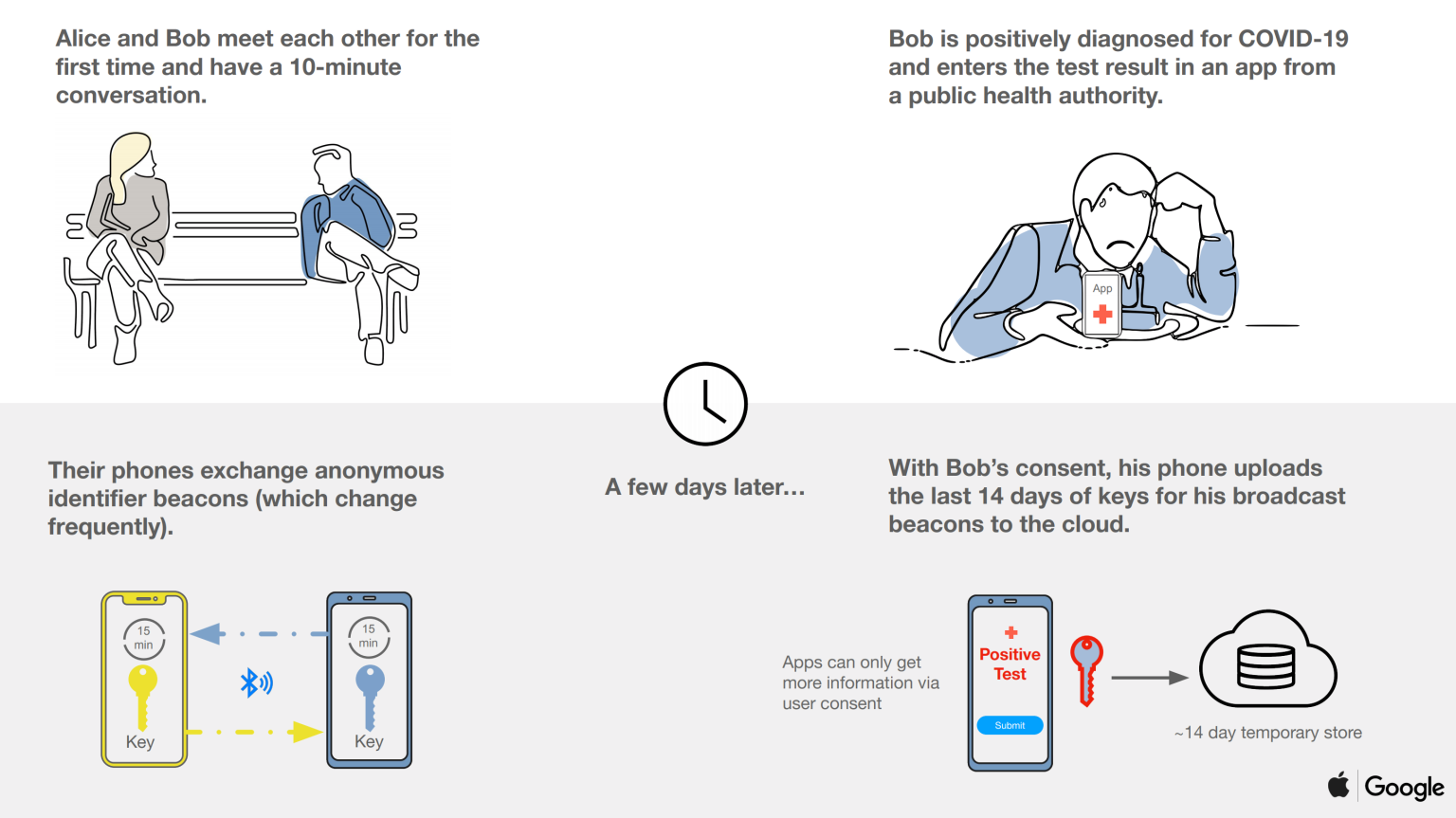
The technology works by tracking device movement to see if a given device has come into proximity with another device that’s associated with a COVID-19-affected person. It does this through the onboard radios on your device which transmits an anonymous ID over short ranges (using BLE).
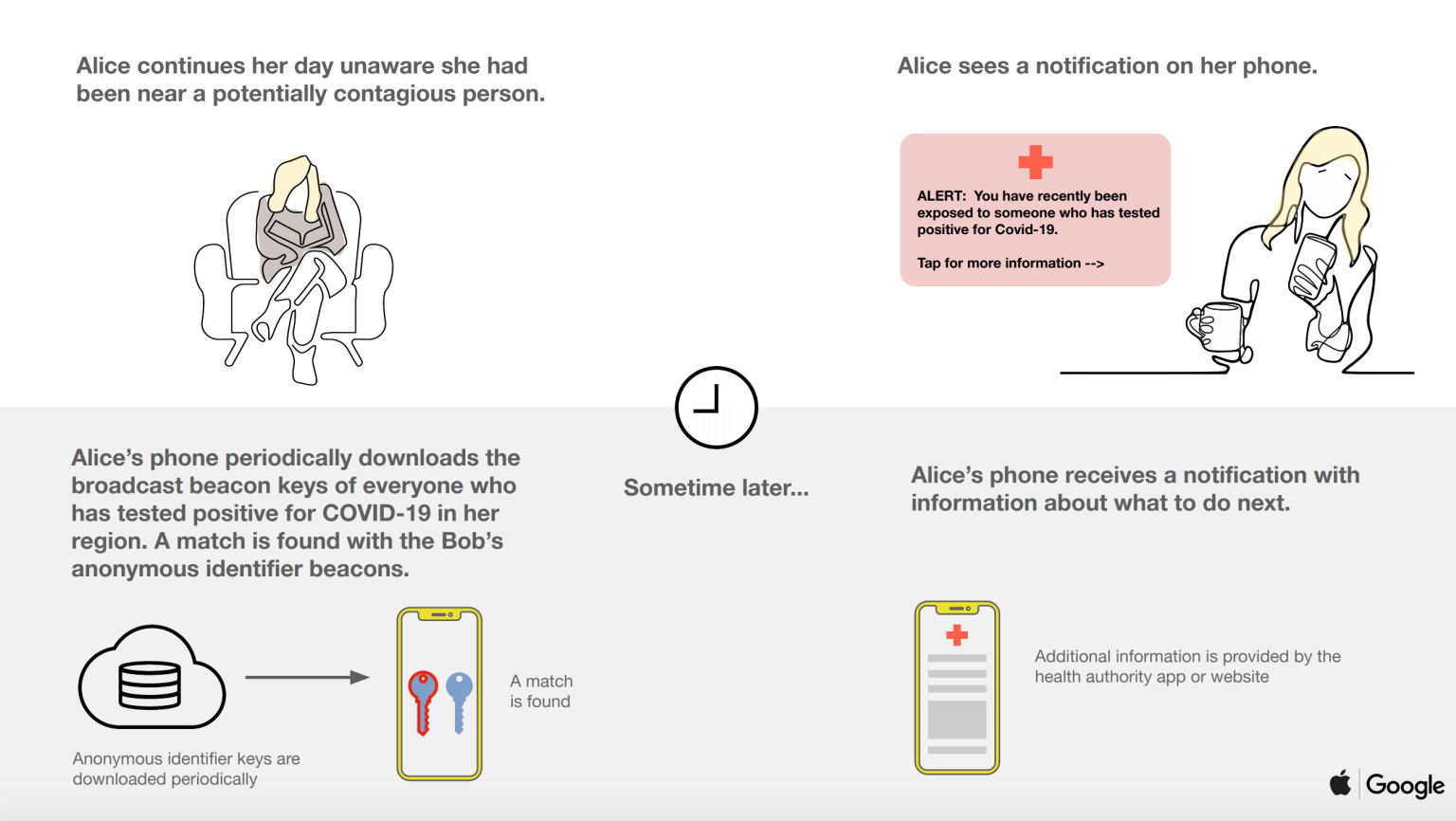
When a given user self reports that they’ve tested positive, the last 14 days of their rotating IDs are relayed by centralized servers to all other devices on the system. When a match is found, the second device is notified. Matches are determined by time-period and proximity alignment between two devices.
Importantly, no GPS data is used — in fact, it’s prohibited. It’s less about where you are on the face of the earth, and more about proximity to other devices. And a “positive” match never leaves the subject’s phone unless they choose to share it. Google and Apple have a collective kill switch for the system.
For more color on this, check out the infographic below.
Finally, What’s next?
We’re in phase I currently, and will be until later this month. There can only be one app per country to avoid fragmentation within geographic areas. But still, there’s some drama rooted in uneven agreement of the system’s merits among various government and health agencies worldwide.
Some governments have pushed back on the decentralized nature of the Google/Apple system, and prefer a centralized system. For example, the U.K. is in that boat but is also rethinking its approach and may adopt the system after all. This will be an ongoing story due to several nuanced geopolitical factors.
One issue — back to the concept of network effect — is that these uncertainties slow down the broad participation that makes the system work. And with delays in integration, there can be gaps in the data needed (14-day time periods) to achieve the “match” readings that the system is intended for.
More about the system functions are below, and additional technical details have been provided by Apple. See the original announcements from Google and Apple and stay tuned for more on this developing story.