

BrightLocal released its annual Local Consumer Review Survey, which covers a range of issues, including local business review habits, the trust and influence of online reviews, responding to and posting reviews. The study surveyed 1,000 US consumers.
Reviews have become increasingly important for consumers and marketers alike, which is reflected in the survey results. Not only are they now one of the fastest-growing local ranking factors, but positive reviews make 68% of consumers more likely to use local businesses.
This year’s survey segmented responses into different age categories (18-34, 35-54 and 55+) in order to better understand how various age groups view and utilize online reviews.
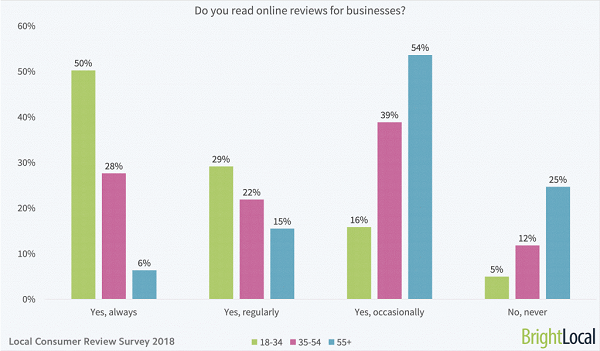
Overall, 86% of consumers read reviews for local businesses this year. The results showed a clear connection between age group and review-usage frequency. Half of consumers 18-34 always read reviews, compared to only 6% of 55+ year olds. Conversely, only 5% of 18-34-year olds and 25% of 55+ year olds said they never read reviews.
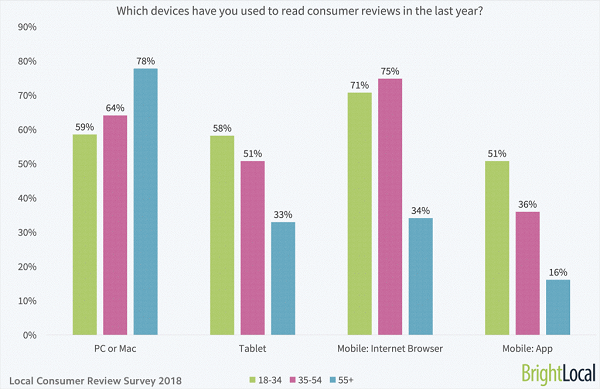
In the aggregate, desktop or laptop computers were the most popular platform for looking at reviews, with 63% of consumers using them. However, that number has dropped a substantial 17% since last year, while mobile platforms grew significantly.
The ease and convenience of mobile viewing made it overwhelmingly the top platform utilized by the two youngest groups at 71% for 18-34 and 75% for 35-54, while PC or Mac was the most popular platform for 55+ year olds at 78%.
Positive reviews made 68% of consumers more likely to use a business, while 40% said that negative reviews make them not want to use a business. Those percentages were unchanged from 2017.
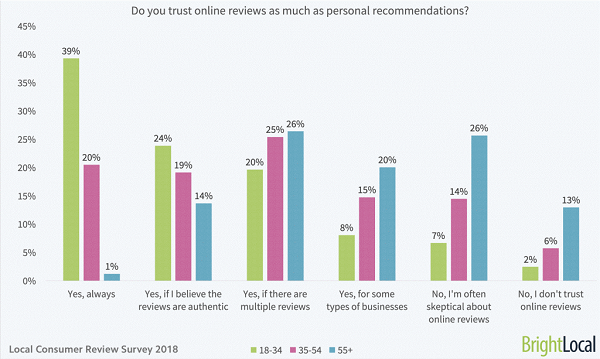
When asked whether or not they trusted online reviews as much as personal recommendations, a whopping 91% of 18-34-year olds said yes in a variety of scenarios. Overall, however, the findings showed a minor decrease in those that trust online reviews as much as personal recommendations since 2017.
In today’s environment, where the term “fake news” is relatively prominent, the study questioned whether this decline in trust can be attributed to the growing number of fake reviews, as it highlighted that 33% of consumers read lots of fake reviews in 2018, compared to 25% in 2017. Overall, however, there was an increase in those who had not read a fake review in the last year, from 21% in 2017 to 26%.
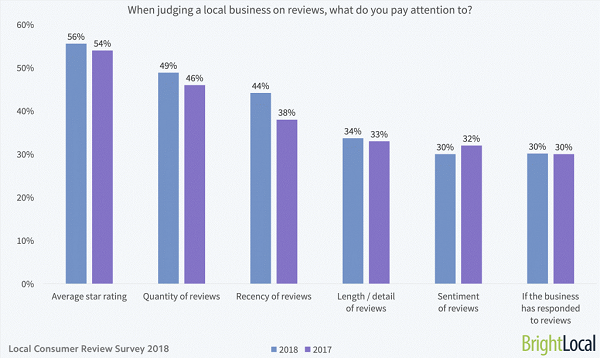
The study also looked at the specific components of a review that consumers pay most attention to. Predictably, average star rating remained the top item at 56%, a 2% increase from last year. It’s not at all surprising that star reviews matter most to consumers, as the data showed that 46% of consumers require a business to have a minimum 4/5-star rating to consider them.
The remaining elements included quantity of reviews, recency of reviews, length/detail of reviews, sentiment of reviews and if the business has responded to reviews.
When it comes to trusting a business, as well as the validity of its online reviews, consumers require businesses to have an average of 40 reviews before believing its star rating. Consumers also read an average of 10 reviews, up from 7 in 2017, prior to trusting a business.
The data also revealed that 85% of consumers believe any online review older than 3 months is irrelevant, and that 40% care only about reviews that happened within the last two weeks.
For an interesting comparison to this research, read LSA’s recent surveys (consumers, SMBs) on reviews and their impact conducted with SOCi.