

Yesterday, Amazon Home Services – originally launched in November as Amazon Local Services – was made available to much of the country, though the high-coverage areas remain LA, New York, San Francisco and Seattle. While the news was expected, the way Amazon is positioning the tool is interesting.
Unlike Yelp and Angie’s List and other major sites for connecting with local businesses, Amazon is placing little emphasis on the business itself and the data associated with the business (reviews, rating, address, phone, etc.). Instead, the focus is on individual services offered and price.

The company claims to “do the homework so you don’t have to” saying that all service providers are invited, vetted and licensed. This pre-approval process allows the company to sell the service instead of the business that provides it and as a result, the company is able to treat services like commodities.
Treating services in this way has some major implications for Amazon, the consumer and the business. It allows Amazon to be the “visible” brand behind the service and transaction; consumers can skip doing the “research” since Amazon does it for them; and businesses are required to be more price competitive.
Amazon clearly wants the ease of purchasing products and goods online to be replicated in the services space. Putting its brand on the line saying, “If you’re not 100% satisfied, Amazon will make it right or give you a full refund,” the company is trusting in its pre-approval process and brand reputation.
When it comes to consumers, they have become accustomed to reading reviews, conducting searches, analyzing websites, etc., in order to make an informed choice on selecting service providers. Amazon buries the business that conducts the service, effectively eliminating differentiation from business to business.
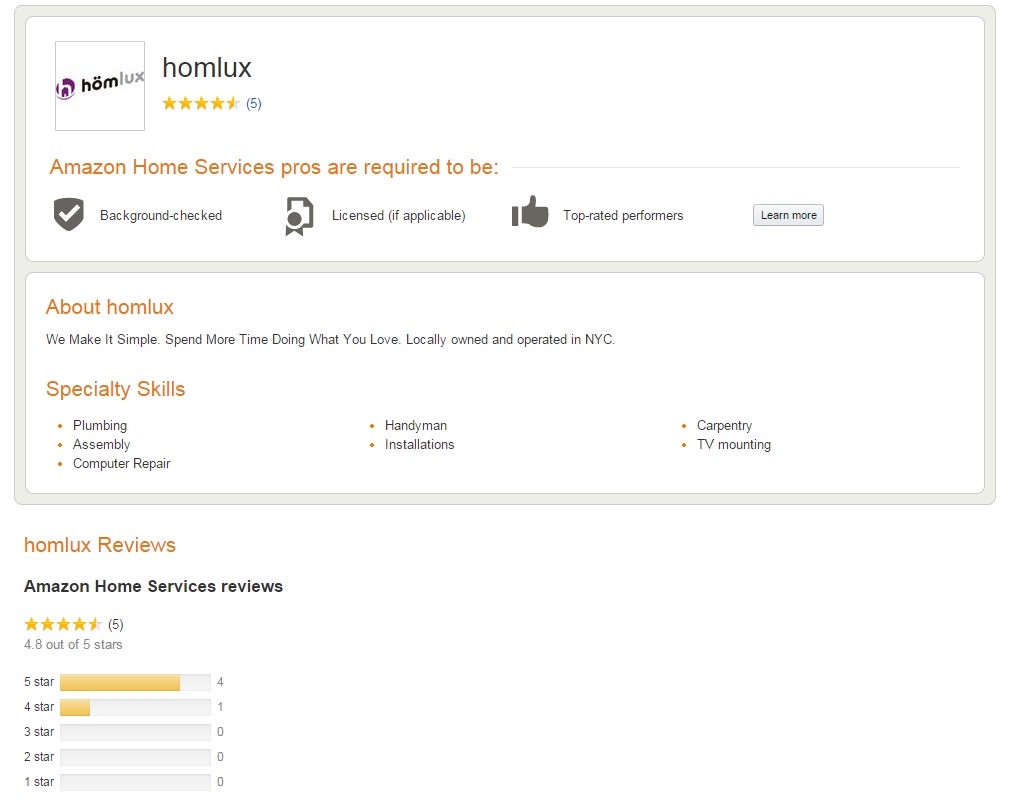
This results in price becoming the primary differentiator. While some consumers are comfortable with inviting a service provider into their home based on price alone, it is highly likely that other consumers aren’t as comfortable with that notion. Amazon does provide links to generic business pages but the business data found there is limited (see example below).
Businesses are then placed in a price war. While many of the prices are just estimates, optics are at play in a major way since the default service attached to the “add to cart” button is in fact the lowest estimate.
Amazon clearly wants uniformity in the purchase process across products and services, but will consumers embrace Amazon’s price centric model for selecting local service providers? Or is more business data necessary for consumers to feel comfortable inviting a stranger into their home?