As AI search changes how consumers find and choose local businesses, a strong Google ranking no longer guarantees the traffic it once did. With more customers making decisions without click throughs, what will determine which businesses win their attention?
Local businesses have traditionally built websites and optimized Google Business Profiles to earn clicks, and the calls, bookings, and visits that followed them. Yet in 2026, those clicks are harder to come by.
Studies comparing click-through rates before and after Google AI Overviews launched found that top-ranking pages lost around 58% of their clicks on average when an AI Overview appeared.
There are, however, signs that the decline may be slowing. More recent research found that organic click-through rates on queries with AI Overviews rebounded 85% in the first two months of 2026. That recovery started from a very low point, though, and a return to pre-AI levels is unlikely.
Thus, local businesses and SEOs are facing an important question: how do you keep winning nearby customers when many of them choose a business without ever opening a listing or clicking through to a website?
Two crucial AI search optimization tactics help. The first is earning mentions in the AI answers customers read instead of clicking, and making sure those answers describe your business favorably. That’s the core of succeeding at zero-click search and AI visibility. The second is making sure your website works for the AI agents that increasingly act on customers’ behalf.
Track Where You Appear Across the Platforms Customers Use
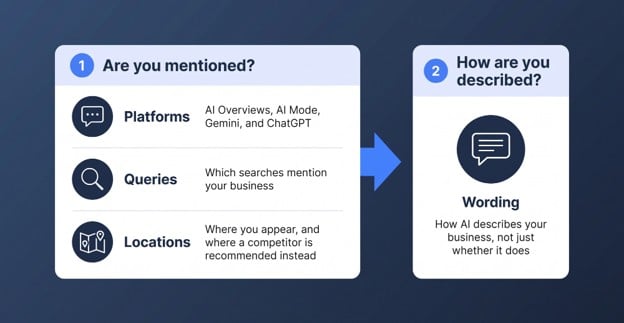
Google still accounts for the majority of local-intent searches, so its generative search experiences come first: AI Overviews, AI Mode, and Gemini. But customers are spreading out, with many now using AI assistants like ChatGPT to discover local businesses.
Each platform draws on different sources and can recommend different businesses for the same query, and a business may appear for searches in one neighborhood and vanish a few miles away. So start with monitoring: which platforms mention you, for which queries, and from which locations. Tools like Local Falcon track local AI visibility by location, showing where you appear and where a competitor is recommended instead.
Keep in mind that being mentioned is only part of it. Customers who don’t click act directly on what the AI says, so the wording matters. A business described as a dependable, well-reviewed choice is more likely to win the customer than one given a neutral description. Understanding how AI describes your business comes from AI brand sentiment analysis.
Optimize for Google’s AI Search Experiences First
Google’s generative AI search features lean on many of the same signals local SEO has historically relied on, so this work builds on what you already do. Keep your Google Business Profile complete and accurate, keep business details consistent across directories, and publish website content that answers the specific questions customers ask. Collect reviews steadily and respond to them too, since AI draws on reviews when it describes a business.
AI Mode and Gemini handle long, conversational requests, so pages that spell out services, hours, service areas, and policies give them more to work with. If AI cautions about your business or repeats a complaint, look for the source, such as a pattern in reviews or outdated website content, and fix it there.
Customers May Skip Your Site, But Agents Won’t
Google’s AI can now help users make reservations, book appointments, buy tickets, and even order food, checking real-time availability across booking platforms and then handing the user to partners such as OpenTable, Resy, Ticketmaster, and Booksy to finish the booking.
Additionally, agentic commerce protocols mean AI assistants can now navigate websites and in some cases complete purchases on a user’s behalf. In other words, sometimes the “visitor” to your website is an AI agent, acting for a customer who never clicks to get to the page.
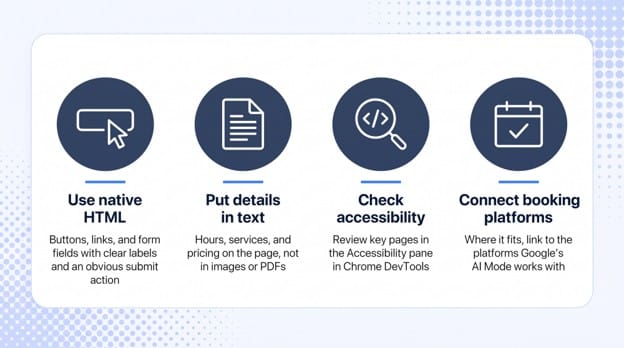
Agents don’t read a page the way people do. Many rely on the accessibility tree, the structured version of a page that screen readers use, sometimes combined with screenshots. Google’s web.dev has published guidance on building sites that work for AI agents, and it comes down to clean semantic HTML and an accessible structure. Here are a few quick tips to get your local business site ready for agentic commerce:
- Use native HTML buttons, links, and form fields with clear labels, and give booking, ordering, and contact forms an obvious submit action
- Put hours, services, and pricing in text on the page rather than in images or PDFs
- Check how your key pages look in the Accessibility pane in Chrome DevTools
- Where it fits your business, connect to the booking platforms that Google’s AI Mode already works with
Some of these agentic features are still rolling out, and certain ones are limited by region or subscription tier. The preparation is low risk, though, and many of the changes made for agents also make sites better for human visitors.
Get Found, Then Be Actionable
Winning local customers without the click comes down to two things. The first is showing up favorably when AI answers a local question, which means tracking your visibility and the language used about you by platform and location, and optimizing for Google’s AI search experiences first. The second is making your business easy for an agent to act on, so a customer who asks an assistant to book a table or an appointment ends up with you.
Clicks may not rule like they once did, but customers still have to choose someone nearby. Ultimately, the businesses who are both visible and actionable are the ones making the sales.