
AI agents are beginning to move local SEO beyond analysis and into execution, automatically monitoring rankings, optimizing Google Business Profiles, responding to reviews, and publishing content at scale. This shift could fundamentally change how local visibility is managed, turning AI from a reporting tool into an operational layer for ongoing optimization.
AI has already changed how local businesses understand their search performance. Now it’s beginning to change who (or what) does the work.
For the past couple of years, AI’s role in local SEO has largely been analytical. Tools like Local Falcon got smarter at interpreting ranking data, identifying visibility gaps, and surfacing competitive insights. The result was better local search intelligence, but the execution was still largely left to the human on the other end of the screen.
That’s changing fast. AI agents, capable of not just generating recommendations but actually carrying them out, are beginning to make their way into local SEO workflows. For businesses managing a handful of locations or agencies managing hundreds, that’s exciting news when it comes to efficiency.
Analyzing (And Acting On) What’s Actually Happening
An AI agent with access to rank tracking data can do more than interpret why visibility dropped in a specific area or which competitors gained ground. It can recognize that a threshold has been crossed — a meaningful ranking decline, a sudden spike in negative reviews, a competitor pulling ahead in a key market — and flag it, escalate it, or trigger a response workflow automatically.
This changes the relationship between data and action. Rather than a practitioner periodically checking dashboards and reactively deciding what warrants attention, the agent monitors continuously and proactively addresses it. For a multi-location brand where no one has the bandwidth to constantly review performance manually across hundreds of locations, that shift from reactive to proactive optimization is where a lot of the real value lies.
Building a Strategy
Analysis is only as valuable as the action it informs. The next step is translating data into a plan — and AI agents are increasingly capable of doing that, too.
Given visibility data, competitor benchmarks, and location-specific context, an agent can prioritize which locations need attention most, recommend what types of optimizations are likely to move the needle, and execute those recommendations in a way that makes sense. Rather than handing a user a list of everything that could be improved everywhere, an AI agent identifies where effort will have the most impact.
This kind of strategic guidance has traditionally required experienced SEO professionals. AI agents don’t replace human expertise, but they make it more scalable — and they ensure the strategic layer doesn’t get skipped just because a business lacks a dedicated local SEO team.
Optimizing Google Business Profiles
GBP optimization is still central to local search, and it’s also one of the most time-consuming tasks to manage at scale — which makes it a natural fit for agentic AI.
AI agents can go beyond recommending changes to business descriptions, categories, attributes, and services — they can make those changes directly. An agent that identifies a gap between how a business describes its offerings and how top-ranking competitors in the same category present themselves can suggest an update and, with appropriate permissions, implement it.
For multi-location operators, this is particularly valuable. Keeping dozens or hundreds of GBP listings current, accurate, and optimized for local relevance is a task that often falls through the cracks without dedicated resources. AI agents bring consistency to that process without requiring proportional increases in headcount.
Responding to Reviews
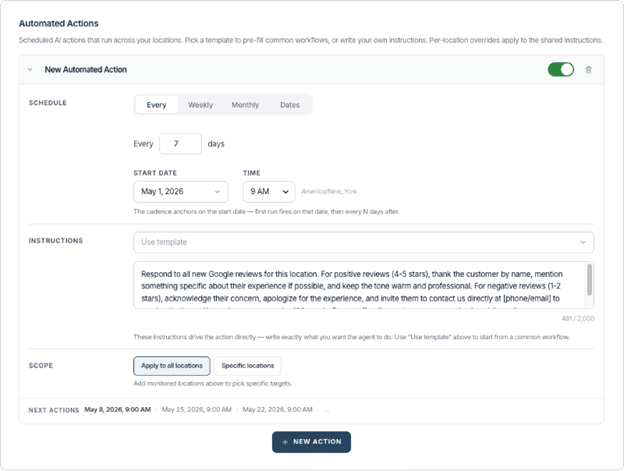
Responding to Google reviews is one of those tasks that everyone knows matters, yet few businesses execute consistently due to time constraints and other priorities. But now, AI agents can monitor incoming reviews and publish responses automatically, calibrating tone based on sentiment and context.
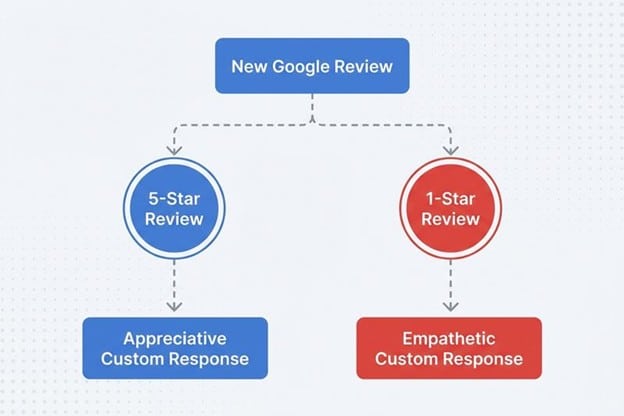
A five-star review from a satisfied customer warrants a different response than a frustrated one-star review. Agents that understand that distinction — and that have access to business context to make responses specific and credible — can handle this at a volume and speed no human team realistically could.
For example, Local Falcon’s built-in Falcon Agent lets users configure per-location Google review response rules directly from within the platform, ensuring every incoming review gets an appropriately customized, on-brand response, rather than a generic one.
Publishing GBP Posts
Google Business Profile posts remain an underutilized channel for many local businesses. Keeping a listing active with posts tied to promotions, seasonal offers, or local events can boost engagement signals and conversions, but it requires consistent effort that often gets deprioritized.
AI agents can generate and publish GBP posts on an ongoing basis according to custom instructions and local context. Posts that reflect what’s actually happening in a business — a new service, an upcoming event, a seasonal offering — perform better and reflect better on the listing. Agents that can generate and distribute that content without a human manually queuing up each post represent a meaningful efficiency gain.
What This Means for Local SEO Practitioners
The emergence of AI agents in local SEO doesn’t change what good local search performance requires — an optimized GBP listing, strong reviews, consistent brand signals across the web, and regular engagement. What it changes is who can realistically achieve that at scale.
For local SEO practitioners, the value is time: time redirected from repetitive execution toward strategy, client relationships, and work that genuinely requires human judgment. The agent handles the volume; the practitioner handles the nuance.
That balance is still being worked out, but the direction is clear. AI agents for local SEO are already here, and businesses and agencies that figure out how to work with them effectively will have a real advantage over those that don’t.