Most local businesses and SEO professionals approaching AI visibility for the first time treat it like a Google rankings challenge. They optimize their Google Business Profiles more aggressively, get more reviews, and then wonder why their AI visibility doesn’t improve.
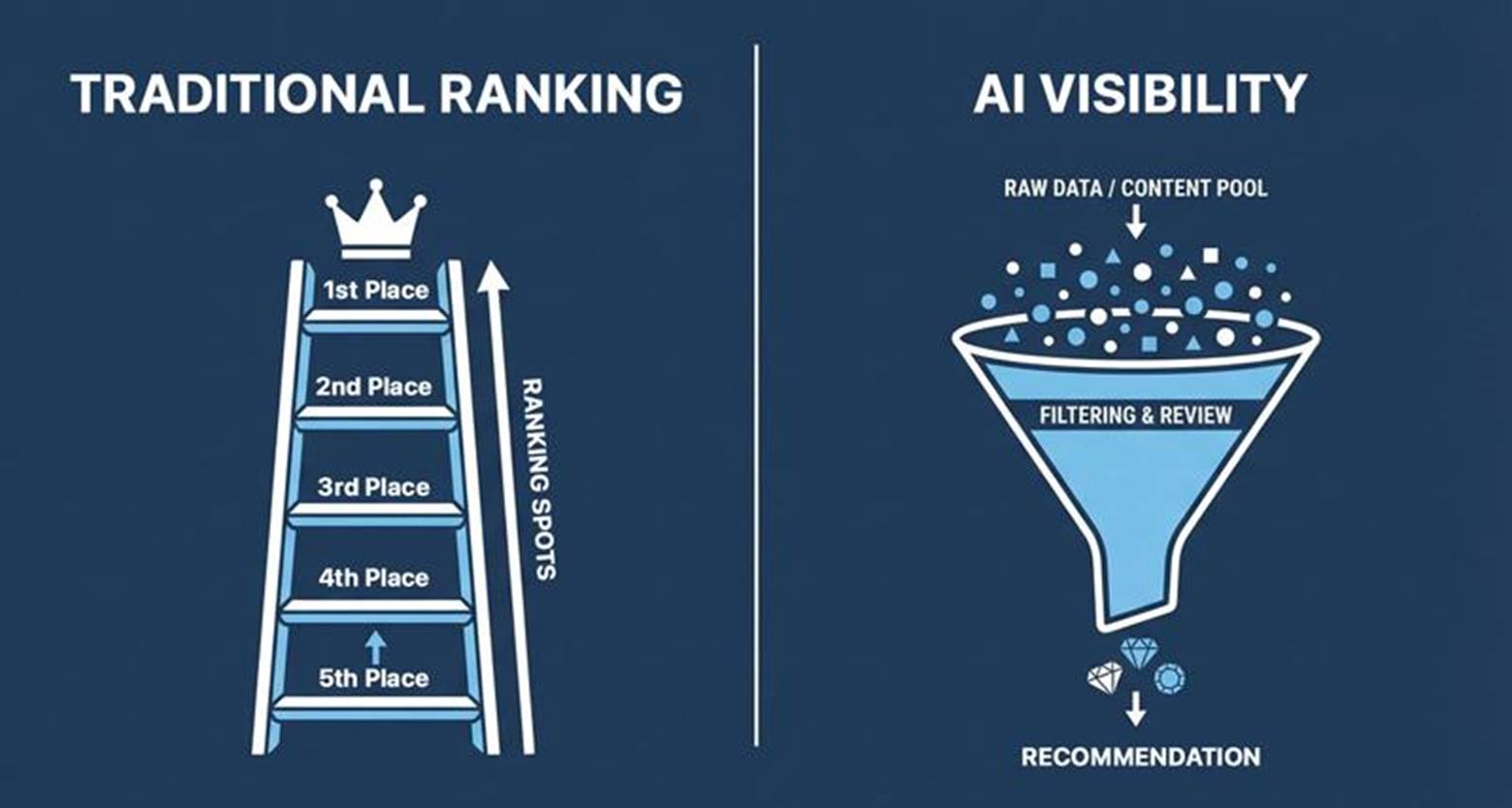
The reason is that AI-generated recommendations don’t work the same as a local search ranking system. AI assistants instead work like a data curation system, and that distinction changes how businesses need to think about being found.
How AI Actually Selects Local Businesses
Traditional local search rankings are built on a relatively well-known set of ranking factors: proximity, relevance, and prominence as Google measures them. Businesses can study these Google rankings factors, benchmark against competitors, and make targeted improvements with a reasonable expectation that better inputs produce better rankings.
AI-generated local business recommendations work differently. Rather than ranking businesses against one another, generative AI synthesizes information from across the web to determine which businesses are worth mentioning to users at all.
Reviews, business profiles, website content, third-party directories, local citations, and broader brand mentions all feed into how AI platforms understand and evaluate a business. While certain sources are cited more than others, no single source dominates, and the weighting can vary significantly by platform.
This is why businesses with strong Google Maps rankings frequently find themselves absent from AI-generated answers. Their Google-specific signals are strong, but their overall data footprint — the sum of structured and unstructured information about them across the web — may be thin, inconsistent, or simply unclear to AI that’s drawing from a much wider pool of sources.
The Numbers Reflect How Selective AI Actually Is
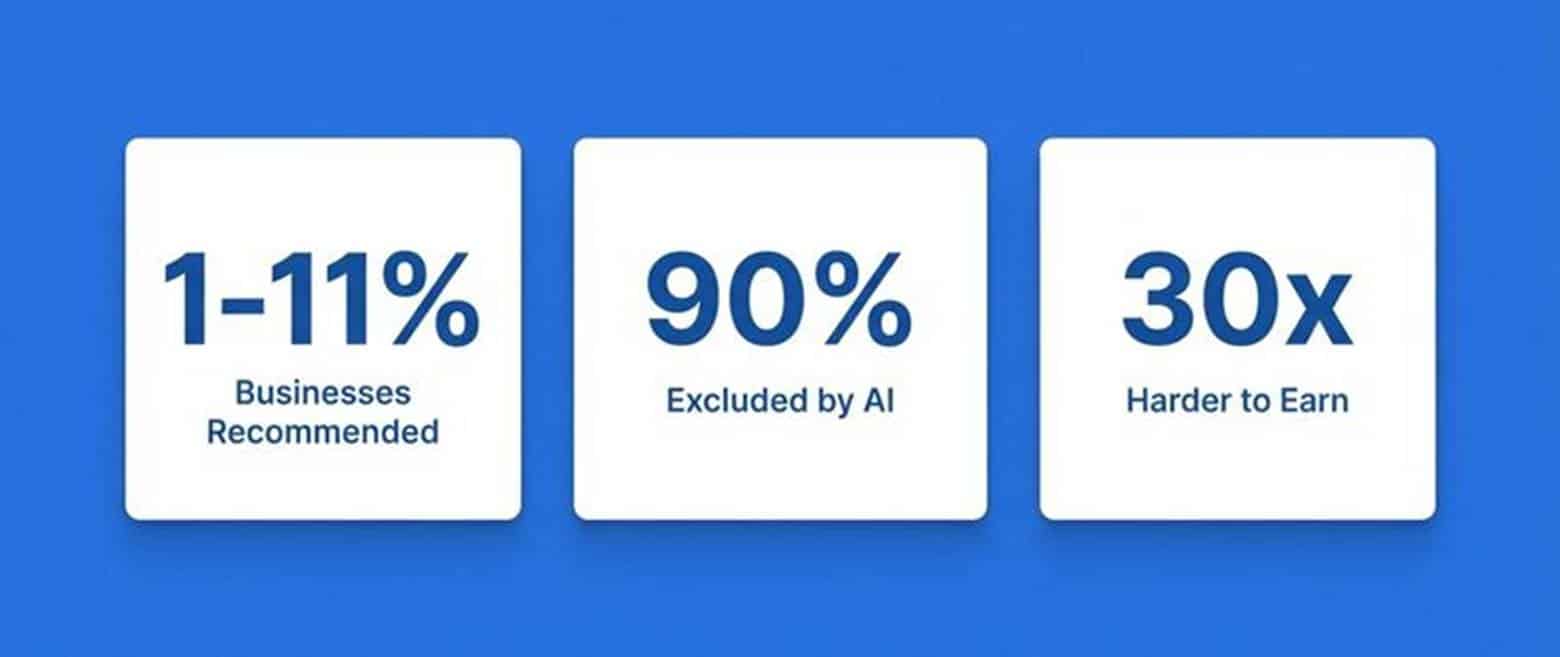
The data on AI visibility makes the challenge concrete. Some recent estimates indicate that AI systems recommend just 1-11% of eligible local businesses for a given query. Even in categories where AI is most generous with recommendations, this means that about nine out of ten relevant businesses are excluded by default. For local businesses, achieving AI visibility is up to 30 times harder than earning a traditional local ranking.
Platform behavior varies considerably as well. ChatGPT recommends the fewest local businesses of the major AI platforms, while Gemini recommends the most — a difference that directly reflects how each system sources its data. Gemini’s closer alignment with Google Business Profile data means traditional local SEO ranking factors carry more weight there. ChatGPT’s reliance on alternative sources, like Bing Places, niche directories, and brand websites, means a different set of factors determines who gets mentioned and who doesn’t.
The cross-platform inconsistency matters more than most businesses realize. A business that invests heavily in Google optimization may perform well in Gemini while remaining invisible in ChatGPT — and have no idea, because they have never measured the two separately. Fewer than half of businesses that rank well on Google appear consistently in AI results overall, and that overlap is unreliable enough that Google performance cannot be used as a meaningful proxy for AI visibility.
Why This Requires a Different Optimization Mindset
The practical implication of all this is that AI visibility demands a broader definition of local presence than most businesses have historically maintained. Optimizing for Google Search and Maps, while still essential, addresses only one key piece of a much larger data picture that generative AI assistants are drawing from when deciding which businesses to recommend.
Businesses that earn strong AI visibility tend to share certain characteristics. Their information is consistent across a wide range of directories and data sources, not just Google. Their website clearly communicates what they do, where they operate, and who they serve. They have a meaningful presence across review platforms beyond Google. And their broader web footprint — brand mentions, citations, third-party coverage — reinforces a clear and coherent business identity that AI can interpret and recommend with confidence.
None of these are entirely new concepts in local SEO. Citation consistency, review diversity, and website structure and clarity have always mattered to some degree. What has changed is how directly and disproportionately they now influence visibility in a channel that operates on a different selection logic than Google. Businesses that have historically treated these as secondary priorities behind GBP optimization may find that their AI visibility reflects exactly that.
Measurement Is the Missing Piece
The reason most businesses have not yet addressed their AI visibility gap is not lack of awareness — it’s lack of measurement. Without data on how often a business appears in AI-generated recommendations, and how that compares to competitors in the same market, there’s simply no way to accurately diagnose the problem or evaluate whether any given optimization effort is having an effect.
Tracking Share of AI Voice (SAIV) across platforms like ChatGPT, Gemini, and Google AI Overviews and AI Mode, broken down by keyword and geography, is now a practical necessity. Tools like Local Falcon make it possible to measure AI visibility alongside traditional local rankings in a single platform, giving businesses the baseline they need to act on real data rather than assumptions. For businesses that have built strong Google performance over time, that measurement will often reveal that AI visibility is the next meaningful gap to close — and that closing it requires expanding the definition of what local presence actually means in 2026.