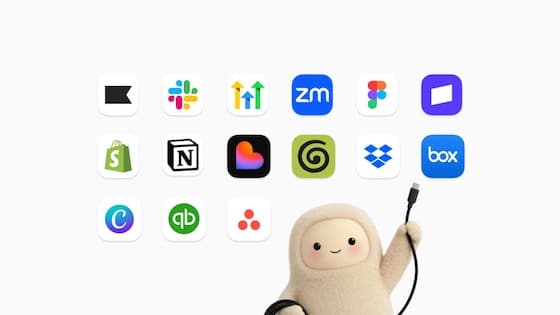
After big updates last week at its Connect event – including the Muse Charm wearable and new VR glasses – Meta followed up this week with an SMB-focused play. Its Muse AI agent is gaining integrations with Shopify, Dropbox, Slack, and others, meant to help SMBs operate and market themselves.
For example, Muse can plug into Shopify to learn what a business sells, then be able to field incoming customer questions. To pull this off, it can also tap into Meta apps, such as an SMB’s Instagram account or Facebook Ads account, to gain a deeper sense of knowledge about the business and its “voice.”
Beyond the above list, the range of integrations for Muse includes Asana, Box, Canva, Figma, Granola, HighLevel, Intuit QuickBooks, Klaviyo, Lovable, Notion, Stripe, and Zoom. That creates a broader set of functional possibilities for SMBs to utilize Muse, including everything from bookkeeping to design.
Goal-Oriented Workflows
But the underlying benefit in what Meta is doing here is to plug Muse into the apps that SMBs already use – thus lowering friction (more on that in a bit). Beyond lowering friction, this move plugs Muse directly into business operations, thus giving it the training and context it needs to do its thing.
What is that thing exactly? It’s all of the time-saving execution of rote work on an SMB’s behalf. And we’re talking about agentic workflows, as opposed to standalone chatbot functions that execute single tasks or answer single answers. The evolution from assistants to agents means goal-oriented workflows.
This evolution could be particularly relevant for SMBs because they’re the most time-starved and tech-challenged. Agentic AI addresses both points – offloading time-consuming rote work, and doing so in the background through plain-spoken prompting. The latter means less software interaction, not more.
“I work about 65 hours a week, and there are so many things where I’m the only one who can do them,” Tom Mulholland, owner of Mulholland Grocery in Malvern, Iowa said in materials provided by Meta. “I need to free up time for the work that actually makes my business money: cutting the steaks, making the sausages. I’m very good at what I do, but that doesn’t mean I’m good at all of the different roles a small business owner has to play, and Muse is taking over a few of them.”
Comfort Bound
Stepping back, Muse’s SMB play also aligns with the growing trend of bringing AI to businesses by integrating it – via APIs and MCPs – with their existing apps. This reduces friction by making AI less intimidating by operating in comfort-bound environments. As Mark Benioff says, the API is the new UI.
Not only is this smart to reduce friction, but it has security advantages. By operating in one’s existing environment, it prevents companies from having to upload all their data to cloud-centric AI environments. That comfort factor inherent in all the above is especially relevant for SMBs, who hold AI trust issues.
Meanwhile, all the above is part of a broader Meta effort to bring AI tools to the enterprise. In fact, Muse for Small Business was launched one day after “Meta Enterprise Platform” was announced. This brings together Muse, Meta Business Agent, Muse API, and Muse Code into one enterprise package.
As for availability, Muse for Small Business is rolling out as a platform that SMBs can get started with at no charge – with usage limits of course. Higher-capacity users get a subscription plan. This freemium play is likely smart to onboard SMBs with the least possible friction (sensing a theme?)