
Google has quietly introduced a change to its review ecosystem that could have outsized implications for local businesses and local SEO: users can now display a pseudonym instead of their real name across all past and future Google reviews. While positioned as a minor account update, the shift towards anonymous reviews lowers friction for reviewers, particularly in privacy-sensitive industries, and introduces new dynamics around review volume, sentiment, reputation management, and local search visibility.
This is less a technical change than a behavioral one. By reducing the social and reputational friction associated with leaving a review, Google Anonymous Reviews is unlocking feedback from customers who were previously willing, but hesitant, to share their experiences publicly.

What Changed: Pseudonyms, Not True Anonymity
It’s important to clarify what Google has actually done. Users are not all of a sudden able to leave one-off reviews from throwaway, untraceable profiles. Instead, they can select a pseudonym that replaces their real name as the public-facing identity on their Google account.
Behind the scenes, Google still knows exactly who the user is. The account history, activity patterns, device signals, and behavioral data all remain intact. The change is purely about what other users and businesses see.
In practice, this lowers the perceived risk for reviewers without removing Google’s ability to monitor potentially suspicious review activity.
Why This Is a Big Deal for Privacy-Sensitive Industries
For many businesses, especially those in privacy-sensitive verticals, review acquisition has always been an uphill battle.
Industries likely to benefit the most include:
- Legal services
- Mental health and therapy practices
- Addiction treatment and rehab centers
- Medical specialists
- Financial and advisory services
In these niches, customers often hesitate to leave reviews because they don’t want their name publicly associated with a sensitive service — even if they had a positive experience.
By allowing a pseudonym, Google has effectively removed one of the biggest psychological barriers to leaving a review. Customers can now share feedback without worrying about friends, employers, or family members connecting the dots.
For these businesses, this update could directly translate into:
- Higher review volume
- Better review velocity and freshness
- Stronger local rankings over time
Will Anonymous Reviews Increase Fake Reviews?
This is the most common concern — and it’s largely overblown.
Fake reviews are already a major problem, but they rarely come from real identities to begin with. Bad actors typically use:
- Fake accounts
- Aged accounts bought or hijacked
- Review farms and coordinated networks
Allowing a pseudonym doesn’t meaningfully lower the barrier for scammers because they already avoid using real names.
More importantly, Google’s existing review protections remain fully in place. Google evaluates far more than just a display name, including:
- Account history and longevity
- Review behavior across locations
- IP patterns and device signals
- Content similarity and timing
Because Google still knows exactly which account is leaving the review, suspicious activity can be flagged just as effectively as before.
In short, review scams are already rampant, and this change is unlikely to increase fake reviews at any meaningful scale.
For Multi-Location Businesses, Reviews Matter More Than Ever
A Potential Downside: More Honest (and More Negative) Feedback
There is, however, a real tradeoff businesses should prepare for.
When people feel less identifiable, they are often more willing to say what they truly think or feel. That means some businesses may see:
- More candid criticism
- More emotionally charged reviews
- Less “polite” feedback
While that can sting, it’s not inherently bad. Honest feedback is often the most actionable.
The real risk comes when businesses ignore sentiment trends. A cluster of negative reviews — especially recent ones — can directly impact:
- GBP engagement
- Consumer trust
- Local pack rankings
This makes review sentiment analysis more important than ever.
Why Sentiment Analysis Is Now (More Than Ever) a Local SEO Requirement
Reviews are not just a numbers game. Volume and star ratings matter, but what people are saying matters just as much.
Businesses should be actively analyzing reviews to identify:
- Recurring complaints
- Operational difficulties
- Staff or service issues
- Mismatched expectations
Catching these patterns early allows businesses to address problems before they spiral into a wave of negative sentiment that damages both reputation and rankings.
From a local SEO perspective, this is critical. Google increasingly rewards businesses that demonstrate strong, consistent customer satisfaction signals over time.
What Businesses Should Do Next
This update doesn’t require panic — but it does require adaptation.
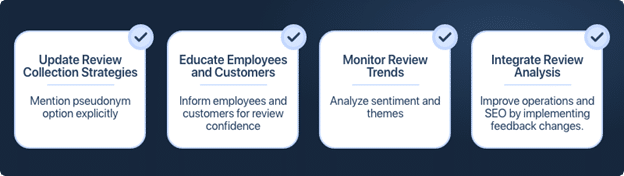
1. Update Review Collection Strategies
Businesses, especially in privacy-sensitive niches, should update their review requests to explicitly mention that customers can now use a pseudonym. This reassurance alone may unlock reviews that previously never materialized.
2. Educate Employees and Customers
Frontline staff should understand the change and be able to explain it confidently. Customers are far more likely to leave a review when they feel informed and safe.
3. Monitor Review Trends Closely
Pay attention not just to star ratings, but to sentiment themes and shifts. Anonymous feedback can surface issues faster — and ignoring it can be costly.
4. Integrate Review Analysis Into Local SEO
Review insights should feed directly into operational improvements, marketing messaging, and local SEO strategy.
Key Takeaways
- Businesses in niches where privacy has historically limited reviews should refresh their review collection strategies and highlight the new pseudonym option.
- Review scams are already widespread, and this update is unlikely to significantly increase fake reviews.
- All businesses should be implementing review sentiment analysis as a core part of their local SEO efforts to protect reputation and maintain or improve rankings.
Google may have rolled anonymous reviews out quietly, but for local businesses, the impact could be loud — in all the right ways if handled correctly.