
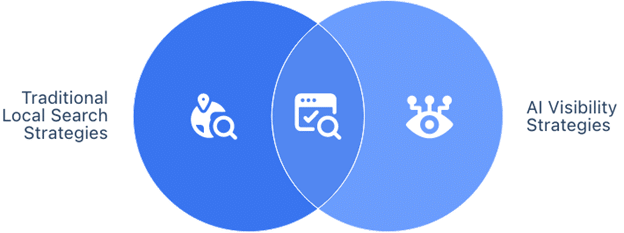
Local search marketing is experiencing one of its biggest periods of change since the introduction of Google My Business, now Google Business Profile, more than a decade ago. To sum it up, AI-driven discovery and evolving customer behavior are fragmenting the world of local search. For many brands, this means that the tactics that worked even two years ago won’t be enough to stay visible in 2026.
To stay competitive and prepare for the year ahead, businesses need to think beyond traditional local search marketing strategies.
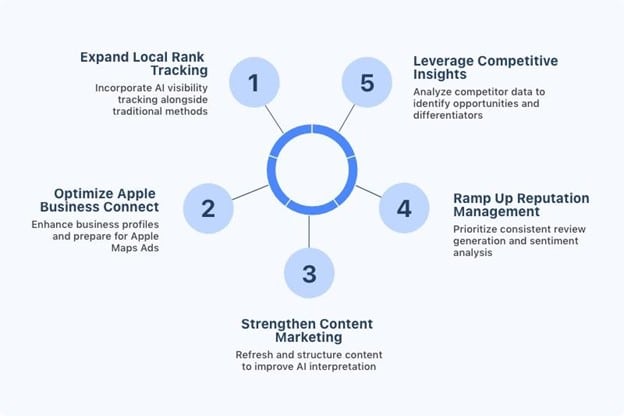
1. Expand on Local Rank Tracking With AI Visibility Tracking
Most businesses still rely heavily on traditional local rank tracking — checking positions in the Google 3-Pack and organic results. While that data is still super valuable, it no longer shows the whole picture.
AI search tools, like Google’s AI Overviews, Gemini, ChatGPT, and other answer engines are increasingly shaping consumer decisions by generating their own tailored recommendations, not just pointing users to search results.
Going forward, it’s important for businesses to understand that you can’t “rank” in AI outputs the same way you do in traditional local search results. Instead, you need to measure Share of AI Voice — how often your brand is mentioned across AI-generated answers within your target market.
In 2026, businesses that understand their AI visibility KPIs will have a clearer picture of their true digital footprint than those relying solely on traditional local rankings.
Explaining the Importance of AI Visibility to Multi-Location Stakeholders
Here are some AI visibility tips for 2026:
- Track brand mentions across AI-driven search platforms
- Understand which topics, queries, or service categories trigger AI recommendations
- Optimize content and citation profiles to increase the likelihood of inclusion
- Monitor competitors’ presence within AI-generated results
2. Optimize Apple Business Connect (Before Apple Maps Ads Roll Out)
Apple Maps has steadily been gaining traction for local discovery, driven by many iOS users defaulting back to Apple Maps after Apple implemented significant design improvements and increased the platform’s accuracy in recent years.
Not only that, but Apple is reportedly moving toward introducing ads in Apple Maps, giving businesses another reason to take their Apple Business Connect profiles more seriously. Those who already have a complete and optimized Apple Business Connect presence will be better positioned to capture more visibility from Apple Maps traffic, both organic and paid.
3. Revisit and Strengthen Your Content Marketing Strategy
Content marketing isn’t new for local businesses, but its importance is increasing as AI-driven models rely heavily on business-generated content to craft recommendations, summaries, and explanations.
AI search tools surface what they can understand, and if a business has thin, outdated, or poorly structured content, it becomes harder for those systems to interpret what the business offers, who it serves, and why users should choose it.
Businesses preparing local search marketing strategies for 2026 should:
- Refresh old blog posts, FAQs, service pages, location pages, and guides
- Add location-specific content that reinforces service areas and specialties
- Provide detailed, helpful answers to common customer questions
- Include structured data wherever possible
- Ensure business details are consistently represented across the site
AI-driven models and traditional search engines alike reward clarity and structure. The more structured, detailed, and useful your content is, the more likely your business is to appear in both AI-generated answers and organic local search results.
4. Ramp Up Reputation Management Across Multiple Platforms
Reviews have always mattered for local search marketing, but they’ve now become one of the strongest cross-platform ranking factors and trust signals, including for AI-driven recommendations.
Local ranking algorithms analyze not only review quantity and score but also recency and consistency across platforms.
To prepare for 2026, businesses should:
- Prioritize steady, continuous review generation rather than short bursts
- Encourage customers to review on multiple sites (Google, Yelp, Tripadvisor, Facebook, industry-specific platforms)
- Use sentiment analysis to improve both service and customer experience (monitor sentiment patterns, address recurring pain points, and lean intro strengths)
- Respond to reviews promptly, especially negative ones
Reviews are now both a direct ranking factor for Google and a training data source for AI models. A strong, diverse review profile increases credibility and performance in traditional search results and boosts the likelihood of being recommended by AI search tools.
5. Leverage Competitive Insights More Strategically
Many businesses look at competitor data only through the lens of rankings. But in 2026, there’s far more value to be extracted.
Businesses should expand their competitive analysis to include:
- Competitor location insights: Use these insights to identify hard-to-compete areas where you could gain visibility faster or supplement SEO with targeted paid ads.
- Negative review sentiment: Look for recurring complaints about competitors and use them as differentiation points in your marketing.
- Highlights from positive competitor reviews: Identify what customers love and aim to replicate or exceed those strengths in your own operations.
- Competitor visibility in AI results: If they’re consistently recommended, analyze what content or signals may be contributing to their presence (sources cited by the AI).
Preparing Your Local Search Marketing Strategy for 2026 Starts Now
2025 was a year rife with changes and learnings in the world of local search marketing, and the businesses finishing the year strong are those that stayed on top of trends and adapted.
Whether your strategy is up to date or not, now’s the time to take another look and start preparing for the new year — it’s sure to be another big one for local search!