For local businesses, visibility is everything. Whether you’re a restaurant, a dental clinic, or a service-area business, showing up when and where your customers are searching drives the calls, clicks, and foot traffic your business depends on. But that visibility can come from two very different places — organic local search engine optimization (Local SEO) and paid advertising (Paid Ads)— and knowing where to invest your time and budget isn’t always clear.
The truth is, local SEO and ads are not mutually exclusive. They work best when used strategically together. The key is understanding when each one delivers the greatest return.
Why Local SEO Is the Long-Term Growth Engine
Local SEO is the foundation of visibility for most brick-and-mortar and service-area businesses. Optimizing your Google Business Profile (GBP), collecting and responding to reviews, building local citations, earning backlinks, and publishing locally relevant content all contribute to stronger organic rankings over time.
The advantage of local SEO is its compounding effect. Once you establish a solid organic presence, you can maintain visibility with relatively low ongoing cost. Unlike ads, which stop driving traffic the moment you stop paying, SEO delivers continuous visibility once earned.
This is why, for businesses that rely on local discovery, organic visibility is the most cost-effective long-term marketing investment. Every organic click represents a customer you didn’t have to pay for, and strong rankings build trust and authority that advertising alone can’t replicate.
The Catch: You Can’t Out-Optimize Proximity
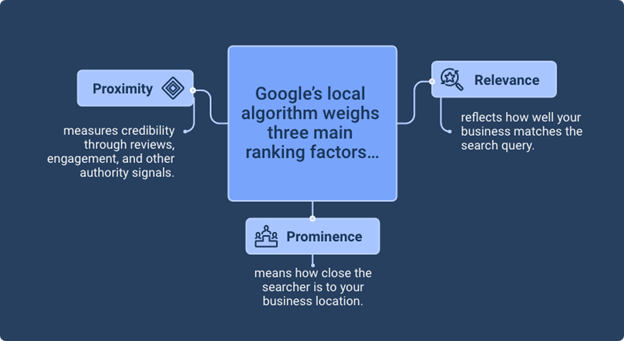
It’s important to understand that local SEO isn’t always a level playing field. Google’s local algorithm weighs three main ranking factors: relevance, prominence, and proximity.
- Relevance reflects how well your business matches the search query.
- Prominence measures credibility through reviews, engagement, and other authority signals.
- Proximity means how close the searcher is to your business location.
Relevance and prominence can be optimized through ongoing effort — you can always refine categories, earn reviews, build citations, get backlinks, and create local content. But proximity is different. It’s based on physical distance between the searcher and the business, and that’s not something you can easily change (short of moving locations or opening a new location).
If multiple competitors have verified locations closer to the searcher than you, they’re more likely to appear first in the local pack for searches in that area. Depending on the density of competition, it’s possible that no amount of optimization can fully overcome that proximity barrier.
In practice, this means you might dominate organic visibility in one part of your city but barely appear in another, even if your local SEO fundamentals are strong.
When To Shift Focus To Paid Ads
Organic reach has natural limits, especially in dense markets. This is where paid visibility comes in. When you’ve optimized your organic visibility to the fullest but still struggle to rank in certain areas, it often makes more sense to supplement with paid ads rather than overinvesting in diminishing SEO returns.
Paid ads can help bridge gaps in local visibility by targeting specific geographies or audience segments that organic reach can’t easily penetrate.
For example:
- Local search ads on Google Maps put your business at the top of map results, even in areas dominated by competitor proximity.
- Google Ads let you target users in zip codes or neighborhoods where you don’t rank organically.
- Local Services Ads (LSAs) help service-area businesses capture leads directly without needing a physical storefront nearby.
Investing selectively in paid campaigns for “red zones” — areas where you’re not visible organically — helps you maintain brand presence and capture valuable search traffic across your target market, regardless of your business’s proximity to searchers.
This approach also helps you avoid waste. Rather than spreading ad spend evenly across your service area, covering areas you already have strong organic visibility, you can direct budget only where organic reach is weak, ensuring every dollar spent actually fills a gap.
When To Double Down on SEO
If your business already ranks moderately well in certain parts of your service area, those are typically going to be your best opportunities for SEO improvement.
Focusing on these “yellow” or “orange” zones often yields the fastest visibility gains. With targeted optimization, you can climb into the top 3 local results and capture high-value, organic visibility that doesn’t require paid support.
This mix of reinforcing existing organic strengths and selectively using ads in weak areas is what creates a balanced local marketing strategy.
The ROI of Knowing Where To Focus
Ultimately, balancing local SEO and paid ads is about knowing when each makes sense.
- Use SEO as your long-term growth engine — it compounds over time and builds brand authority.
- Use ads as your tactical accelerator to reach audiences in locations or situations where organic ranking can’t.
This combined approach lets you maximize visibility, control costs, and ensure your brand shows up where it matters most, no matter how competitive the market is.
And when you have access to the right data, such as highly visual, geo-grid rank tracking insights showing where your business ranks across the map versus where competitors are clustered, you can make confident decisions about when to focus on local SEO vs paid ads. Instead of guessing, you’re using data to guide every marketing dollar toward where it can make the greatest impact.